
The failure points our extension sources name most are contamination, dry air, the wrong temperature, no fresh air and logs left to dry out. Most are easy to prevent once you know the stage they hit. This post lists seven, says what the sources say about each, and links to the guide that covers it. The sources rank none of them, so the order below is ours, and where a source is silent we say so instead of guessing.
1. Letting contamination in
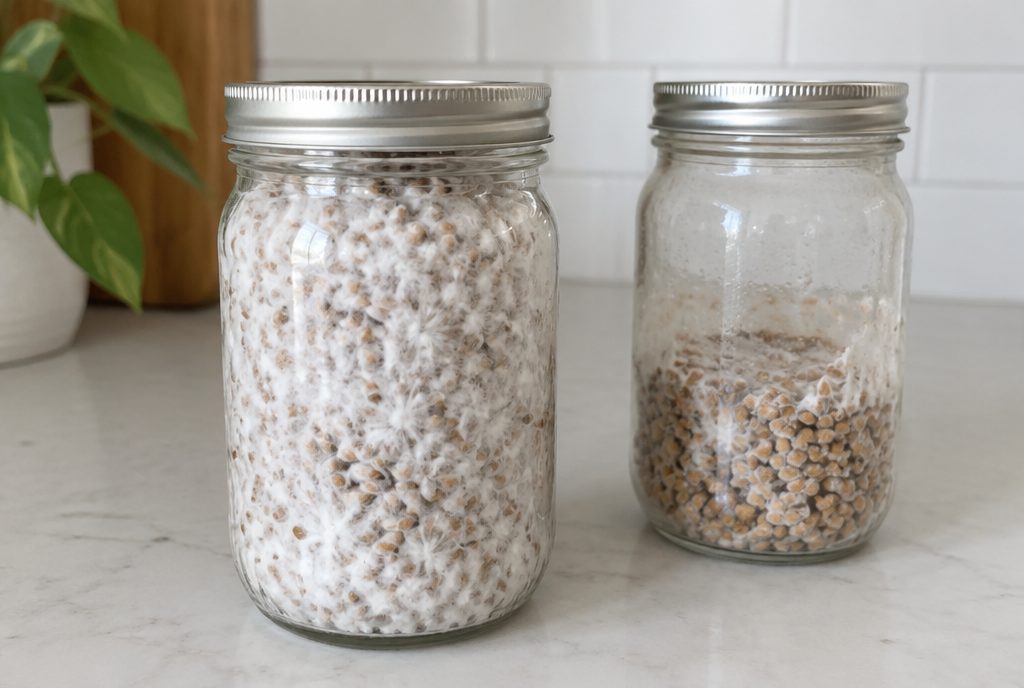
UF says blue, green, black or yellow spots on a bag indicate contamination, and that rapid greenish growth is typical of Trichoderma. Heavily contaminated bags are best removed and discarded, and our sources give no way to rescue one. The prevention steps they do give are heat-treating the substrate, cleaning the work surface with 70% ethanol, flaming metal tools and, for transfers, working in a still-air chamber or hood. See mushroom contamination and mushroom substrate, where UF and Cornell differ on pasteurizing straw.
2. Treating every number as universal
The 5 to 10% spawn rate you may see is UF’s figure for oyster on straw. It is not a rule for every species. Our mushroom spawn guide explains which figures belong to which spawn and species.
3. Letting the air get too dry
Fruiting wants high humidity. UF holds about 90% for oyster, and Cornell’s fruiting room held 85%. Wisconsin’s bucket method has you spray the outside of the bucket with water to keep humidity up once pins form. A kit that stalls is the usual place to check this first, and our grow kits guide covers it.
The opposite mistake exists too. For lion’s mane, Purdue says water trapped between the spines can distort the mushroom, so raise the humidity of the air and keep water off the mushroom. See lion’s mane.
4. Getting the temperature wrong for the stage
Stages want different temperatures, and the figures are species-specific.
| Stage | What the sources say |
|---|---|
| Oyster spawn run | UF gives 24–25°C (75–77°F); Cornell says about 70°F and never above 80°F |
| Oyster fruiting | Light plus a lower temperature, about 20°C (68°F) (UF) |
| Shiitake blocks | Below 55°F after week 4 or 5, blocks fruit early and yields drop (Cornell) |
| Shiitake logs | Soak once night temperatures average above 50°F (Cornell) |
| Wine cap, fruiting | In one review, about 24°C gives slender mushrooms prone to early cap opening; about 16°C gives stout ones |
See oyster and shiitake from sawdust blocks. The wine cap row is a research-review figure, not extension advice.
5. Skipping fresh air
High humidity with no air exchange is its own problem. UF says fruiting needs good air exchange so carbon dioxide does not build up, and Purdue says fresh air exchanges are a must for gourmet mushrooms. A sealed box is not a good fit. Neither source gives a rate, so watch the mushrooms and follow your kit’s instructions. Cornell says CO2 is not important during oyster incubation, so this applies to fruiting.
6. Waiting too long with logs, and letting them dry
Cornell says not to wait longer than three weeks after felling to inoculate, because the log is then more likely to be infested with competing fungi or to dry out. Wisconsin says to rest cut logs two weeks first, so inoculating between two and three weeks fits both, which is our reading. Both Wisconsin and Cornell say to seal every hole with wax to prevent contamination and drying out. Cornell also names red maple, poplar, black locust, fruit wood and ash as less suitable species. See growing mushrooms on logs and shiitake on logs.
7. Picking too late
Cornell says oyster caps that have flattened out are less palatable and drop spores, so pick while the cap is still curled under. Lion’s mane is ready when the teeth are about 1 cm (0.4 in) long and drooping, and Kentucky says to pick wine cap while the cap is bell-shaped and the gills are white. See the oyster, lion’s mane and wine cap harvesting pages.
A quick check when a batch stalls
Work through the list in order. First look at the bag or jar for colored spots, since a contaminated batch cannot be fixed (UF). Then ask what stage you are in and whether the temperature suits it. Then check humidity and air together, because UF stresses holding both at once during fruiting. Last, compare your wait with the sourced range for your route. Change one thing at a time, so you know which one worked. Our sources give no other troubleshooting steps for kits, and we do not invent any.
Slow is not always a mistake
A quiet bed or log may simply be on schedule. Wine cap takes 2 to 6 months (Cornell, NC State), and shiitake logs 6 to 18 months. See how long mushrooms take to grow before you assume something is wrong.
Where to start
New to all of this? Read our guide to growing mushrooms, or browse the beginner mushroom collection.
Frequently asked questions
Why are my mushrooms not growing?
Our sources name a few causes: contamination, humidity that is too low, no air exchange, a temperature outside the range for the stage, or a log that dried out. Check the spots, the air and the temperature first. A slow first season can also be normal, since wine cap takes 2 to 6 months and shiitake logs 6 to 18.
What is the most common mushroom growing mistake?
Our sources do not rank mistakes, so we cannot say. Contamination comes up at every stage, and UF says heavily contaminated bags are best discarded.
Can I save a contaminated mushroom bag?
Our sources give no way to rescue one. UF says blue, green, black or yellow spots indicate contamination and heavily contaminated bags are best removed and discarded.
How much fresh air do mushrooms need?
UF says fruiting needs good air exchange so carbon dioxide does not build up, and Purdue says fresh air exchanges are a must for gourmet mushrooms. Neither gives an air-change rate.
Sources
- Oyster Mushroom Cultivation (SS662), University of Florida IFAS Extension
- Spawn and strain production for oyster mushrooms (SS663), University of Florida IFAS Extension
- Seven Stages of Cultivation, Cornell Small Farms
- Inoculating Logs, Cornell Small Farms
- Shiitake Cultivation Best Management Practices, Cornell Small Farms
- Mushrooms in Buckets, University of Wisconsin Extension Forestry
- Mushrooms on Logs Using Sawdust Spawn, University of Wisconsin Extension Forestry
- Growing Gourmet Mushrooms, Purdue Extension
- Gourmet and Medicinal Mushrooms (CCD-CP-079), University of Kentucky Center for Crop Diversification
- Review of wine cap (Stropharia rugosoannulata) cultivation, Peer-reviewed review (PMC12364752)