

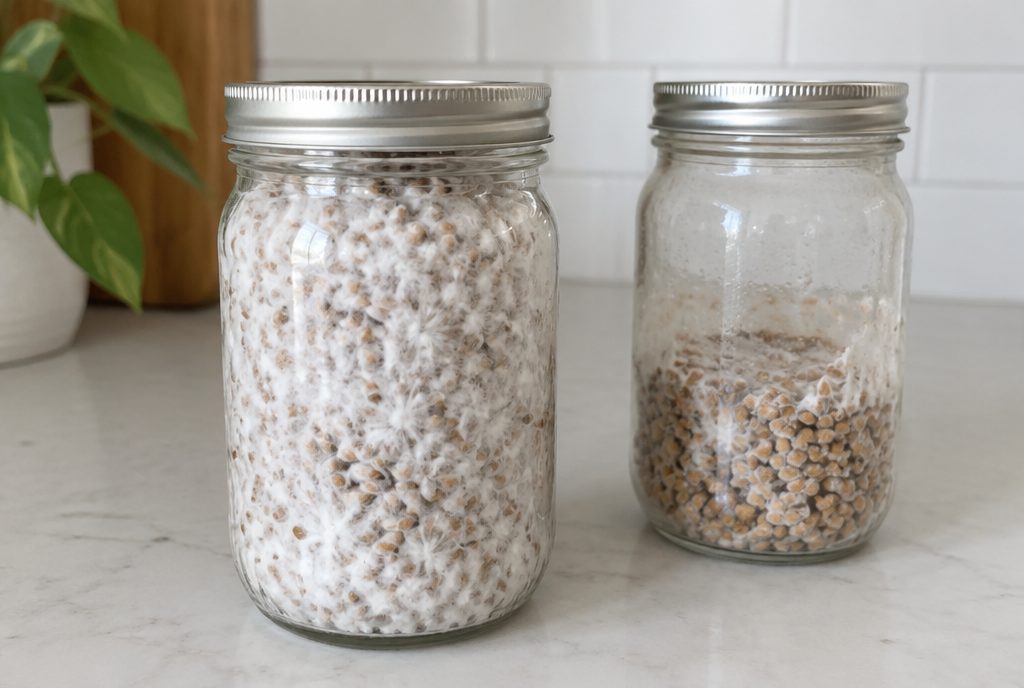
Mushroom spawn is a carrier, usually grain, sawdust or a plug, that is full of living mycelium and is used to start a new batch of substrate. Think of it as the seed stock for a mushroom crop, except that you are transferring a living fungus, not a seed. Cornell lists three common forms: grain, sawdust and plug. This guide covers what each is for, how spawn is made in general terms, how much to use and how to store it. It is one stage in our guide to growing mushrooms.
The three forms of spawn
| Form | What it is | Where our sources use it |
|---|---|---|
| Grain | Cereal seed colonized by mycelium | Oyster on pasteurized straw, mushroom buckets (UF, Wisconsin) |
| Sawdust | Sawdust colonized by mycelium | Logs and blocks (Cornell, Wisconsin) |
| Plug | Colonized plugs, hammered into drilled holes | Logs (Cornell) |
Grain spawn. UF says grain spawn uses seeds such as millet, wheat, sorghum and rye, and calls millet an excellent seed for oyster spawn. It is the form our sources use for straw and for the bucket method, where Wisconsin packs grain spawn with wood chips in a 5-gallon bucket. For the full bucket steps see our grow kit guide.
Sawdust spawn. Both Cornell and Wisconsin use sawdust spawn on logs. Cornell says it is placed in drilled holes with an inoculator, and Wisconsin’s log guide is built around it. Cornell also notes that the spawn used for logs and bulk blocks is typically sawdust and mycelium.
Plug spawn. Cornell says plug spawn is hammered into the drilled holes. Both forms are then sealed over with food-grade wax. Our log guide shows where spawn fits in that process.
Our sources do not compare the three forms head to head, so we do not rank them. The practical rule from them is to match the form to the substrate: grain for straw and chips, sawdust or plug for logs.
How spawn is made
The following is the general process, not a bench protocol. UF says spawn is made by inoculating grain with mycelium from pure cultures. Penn State describes the same start for its production process: sterilize a mixture of grain, water and chalk, then add the mycelium.
- Prepare the grain. UF says seeds should be soaked for about twelve hours.
- Sterilize it in containers. UF sterilizes the seeds inside jars by heat and vapor pressure in a pressure cooker. In general, 30 minutes at 15 psi is suggested.
- Inoculate under clean conditions. UF says to do this ideally inside a still-air transfer chamber or a laminar flow hood to avoid airborne contamination.
- Let the mycelium colonize the grain. It then becomes spawn.
The Penn State text describes spawn for mushroom compost, the Agaricus button mushroom, so we use it only for the shared steps of sterilizing grain, water and chalk and then adding mycelium. The detail of the UF protocol is for oyster. Making spawn is also where contamination risk is highest, so see clean technique before you try it.
How much spawn to use
For oyster on straw, UF says to mix spawn into pasteurized straw at 5 to 10% by volume or by weight.
| Substrate | Rate | Source |
|---|---|---|
| Pasteurized straw, oyster | 5 to 10% volume/volume or weight/weight | UF/IFAS SS662 |
| Shiitake logs | Not stated | Cornell gives no per-log rate |
| Sawdust blocks, other species | Not stated | No fetched source |
That 5 to 10% figure is UF’s protocol for oyster on straw. It is not a universal rule, and our sources do not give a rate for logs or other species. For logs, Cornell does give the hole pattern instead: start 1 inch from the end, drill holes 3 inches apart in rows, with as many rows as the log has inches of diameter. That is a count of holes, not a spawn percentage.
Commercial and home scale
Spawn production is a lab process at commercial scale. UF/IFAS SS663 is a home-scale protocol, but it still assumes a pressure cooker, pure cultures and a transfer chamber or hood. If you do not have those, the simpler route is to start with ready-made spawn or a colonized kit. Our sources do not cover how to assess the quality of ready-made spawn, so we do not offer a test.
Storing spawn
UF keeps stored strains stable on media or as spawn stocks at 4°C (39°F) for non-tropical Pleurotus strains, and keeps mother cultures at 4°C, subculturing them every 6 to 12 months.
Two limits on that advice. It is for oyster, and the word “non-tropical” matters: UF does not say the same for tropical strains. And it is for stocks and mother cultures kept in a lab-style setup. Our sources give no shelf life for finished retail grain spawn, so we do not state one.
Mother cultures and agar
Mother cultures are the pure cultures from which spawn is started. UF’s protocol keeps them on agar media, and its recipe is potato dextrose agar (PDA). Our contamination guide covers agar basics.
Handling the pressure cooker
UF’s advice on the sterilizing step is short and worth repeating. Let the cooker cool before opening it, and do not open it while there is positive pressure inside, or the media may boil over. Block bags in Illinois Extension’s description run hours under pressure, which is a commercial schedule, not the 30 minutes UF suggests for jars of grain.
What happens after you add spawn
The spawn runs through the substrate. For oyster on straw, UF gives a spawn run of 2 to 3 weeks in the dark at 24 to 25°C (75 to 77°F) and 80 to 90% humidity, and Cornell says to keep incubation near 70°F and not above 80°F. UF says pinning begins about 3 weeks after incubation starts. Cornell’s crop cycle on straw is about five weeks from inoculation to harvest, so the two figures may be measuring different points in the same process (our reading). Shiitake on logs is far slower, at 6 to 18 months (Cornell).
Common mistakes
- Using 5 to 10% everywhere. It is the oyster-on-straw rate (UF), not a rule for logs or other species.
- Skipping the soak. UF soaks seeds for about twelve hours before sterilizing.
- Working in open air. UF says to inoculate ideally inside a still-air transfer chamber or a laminar flow hood.
- Storing spawn warm. UF’s stocks and mother cultures are kept at 4°C (39°F).
Making your own
Making your own spawn needs a pressure cooker, pure cultures and clean technique, as UF’s protocol assumes. If you do make it, follow the full sterile routine in our contamination guide.
Choosing a substrate to match
Spawn does not do the work alone: it needs a substrate it can digest. See mushroom substrate for what to pair with spawn, and the oyster and shiitake pages for the species figures.
Frequently asked questions
What is mushroom spawn?
Spawn is a carrier, such as grain, sawdust or a plug, that is full of living mycelium and is used to start a new batch of substrate. Cornell lists three common forms, grain, sawdust and plug. UF describes it as being made by inoculating grain with mycelium from pure cultures.
How much spawn should I use?
UF gives 5 to 10% spawn by volume or by weight when mixing spawn into pasteurized straw for oyster mushrooms. That figure is for oyster on straw and is not a general rate. Our sources give no per-log or per-block rate for shiitake or other species.
What is the best grain for mushroom spawn?
UF names millet, wheat, sorghum and rye seed as options and calls millet an excellent seed for oyster spawn. It says seeds should be soaked for about twelve hours before sterilizing.
How do you store mushroom spawn?
UF keeps spawn stocks and mother cultures at 4°C (39°F), and says mother cultures are subcultured every 6 to 12 months. Our sources give no shelf life or storage advice for finished retail spawn.
Sources
- Spawn and strain production for oyster mushrooms (SS663), University of Florida IFAS Extension
- Oyster Mushroom Cultivation (SS662), University of Florida IFAS Extension
- Mushroom Production and Harvesting, Penn State Extension
- Seven stages of cultivation, Cornell Small Farms
- Mushrooms on Logs Using Sawdust Spawn, University of Wisconsin Extension Forestry