
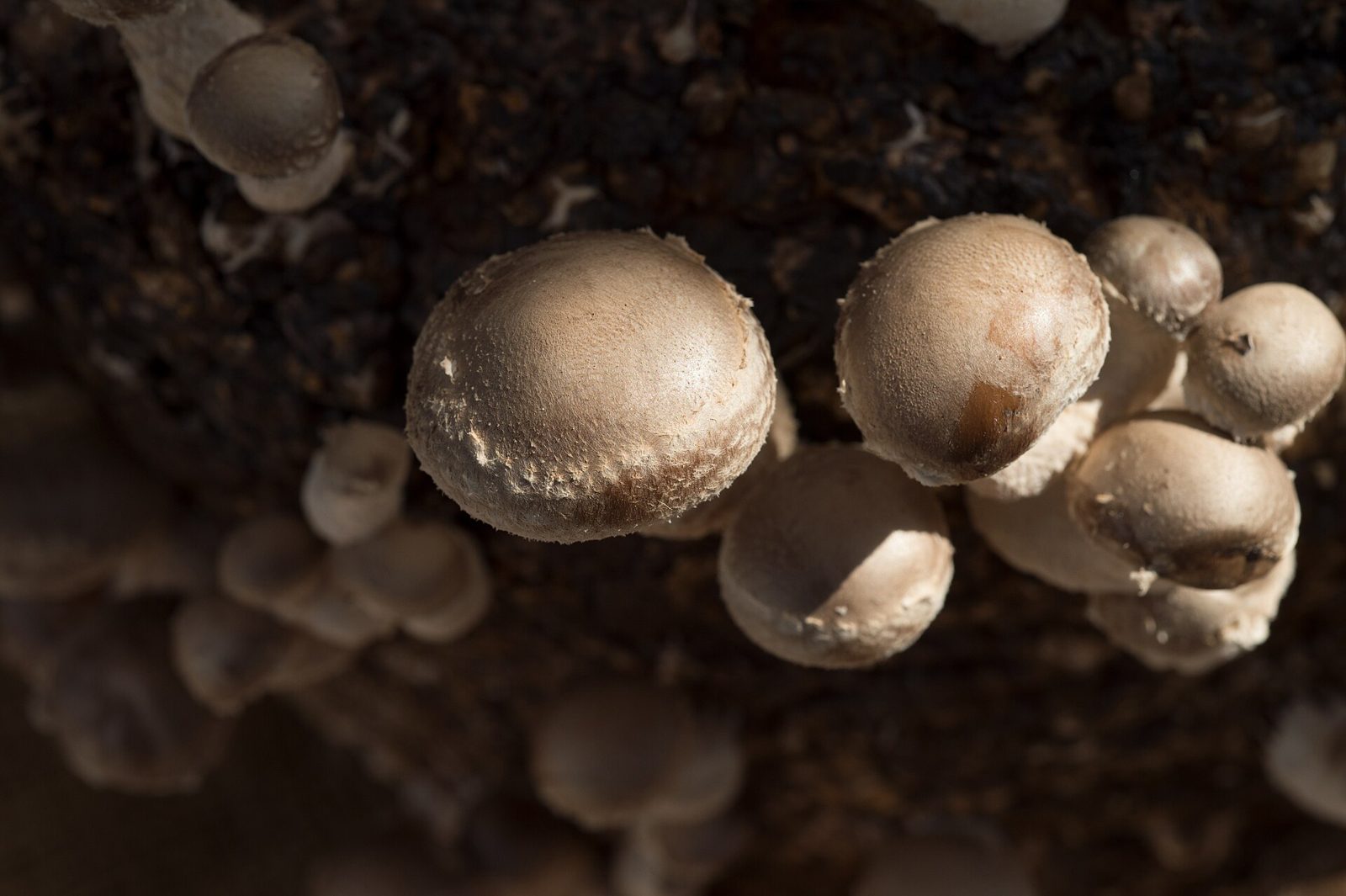
The classic way to grow shiitake is on freshly cut hardwood logs, and the catch is patience: logs take 6 to 18 months to incubate before the first harvest. You drill holes in oak or maple logs, press in spawn, seal the holes with wax, and wait. After that a log fruits in flushes for three to four years, according to Cornell. If you cannot wait that long, supplemented sawdust blocks are the indoor alternative Cornell says most specialty growers use, and we cover them in our shiitake from sawdust blocks guide. Most of our numbers come from Cornell’s commercial guides for the northeastern US, so treat them as a reliable framework rather than a promise for every backyard.
- Substrate
- Fresh-cut hardwood logs
- Days to first harvest
- 6–18 months on logs
- Fruiting temp
- Depends on strain
- Spawn
- Plug or sawdust spawn
- Yield
- About 8 oz per flush
- Log lifespan
- 3–4 years (Cornell)
Logs or sawdust blocks?
Hardwood logs
Sawdust blocks
Shiitake growing conditions by stage
The table lists only what our extension sources state. A dash means they do not give it, and several shiitake numbers are in months or hours rather than days, so those sit in the notes column.
| Stage | Days | Temperature | Light | Notes |
|---|---|---|---|---|
| Log incubation (spawn run) | Not stated | Not stated | Not stated | 6–18 months (Cornell). Maryland: fruiting begins 6–18 months after inoculation. Wisconsin: first mushrooms after about 12 months. |
| Sawdust block, after full colonization | 28–35 days | Stay above 55°F | Not stated | Cornell: 4–5 weeks of further incubation. If temperatures drop below 55°F after week 4 or 5, blocks tend to fruit instead of browning, greatly reducing yields. |
| Forcing (shocking) a log | Not stated | Cold-water soak; nights averaging above 50°F | Not stated | Soak for 12–24 hours (Cornell basics) or 24 hours (Cornell forcing page; Wisconsin). |
| Pinning and fruiting | 3–5 days | Not stated | Clear tarps act like a greenhouse in direct sun; use with caution | Pins appear 3–5 days after soaking as bumps about the size of a pencil eraser. A fruiting cover keeps humidity consistent. Fruiting temperature depends on strain. |
| Rest between flushes | 42–56 days | Not stated | Not stated | Cornell: rest logs for 6–8 weeks before forcing again. |
On timing, Cornell and Maryland give 6–18 months to first fruiting while Wisconsin says about 12, so plan for the long end if your first logs are slow. Strain also changes the season. Cornell groups shiitake strains into Wide Range (the favorite of commercial growers and beginners, and the one Cornell recommends if you try only one), Warm Weather strains, which produce the highest-quality mushrooms in hot summer months and early fall, and Cold-Weather strains, which tend to fruit in early spring and late fall and need a longer spawn run.
How long the whole cycle takes
Shiitake is a multi-year project, and the timeline is the first thing to plan around. Inoculate the logs, then wait 6 to 18 months for them to incubate. After the first soak, pins appear in 3 to 5 days. A log then rests 6 to 8 weeks between forcings, and it keeps fruiting twice a year for three to four years, with upwards of 8 ounces of mushrooms in each flush (Cornell). In a Cornell trial, average yield per log ranged from 0.5 to 2.3 pounds depending on strain, with LE-46 performing best, so the range between strains is wide.
Plug or sawdust spawn?
Cornell says spawn comes in three common forms: grain, sawdust and plug. Logs use the last two. Plug spawn is very simple, needing only a drill and a hammer or mallet. Sawdust spawn is slightly cheaper but needs a special tool, an inoculator, either purchased or homemade, to insert it into the holes. Our sources do not give a spawn amount per log. Our spawn guide explains the forms.
How to grow shiitake on logs
- Choose a strain. Cornell recommends a Wide Range (WR) strain if you try only one. Cold-weather strains need a longer spawn run than the others.
- Cut the right wood. Use live, dormant hardwood. Oak, sugar maple, hop-hornbeam and musclewood are top-tier; red maple, poplar, black locust, fruitwood and ash are less suitable. Wisconsin’s log size is 3–8 inches in diameter and 36–40 inches long.
- Inoculate promptly. Cornell says not to wait longer than three weeks after cutting, or the log may be infested with competitive fungi or dry out. Wisconsin advises resting cut logs for two weeks first, so sources differ. Winter and spring are ideal, though summer and fall inoculations also give sizable harvests (Cornell).
- Drill and fill. Start 1 inch from the end of the log and drill holes 3 inches apart in rows along its length, with as many rows as the log has inches of diameter (Cornell). Insert plug spawn with a hammer, or sawdust spawn with an inoculator tool.
- Seal with wax. Cover each filled hole with melted food-grade wax. Wisconsin says this prevents contamination and drying out.
- Wait and rest. Stack logs in a laying yard and wait. Cornell says growers who waited longer before the first shock got significantly greater production.
- Force a flush. Once night temperatures average above 50°F, soak the logs in cold water. Pins appear in 3–5 days. See our shiitake harvesting guide.
Common shiitake problems
Harvesting shiitake
Look for pins about the size of a pencil eraser 3–5 days after the soak, and protect them from rain, particularly 2–3 days before picking (Cornell). Maryland Extension says to harvest when the caps are about two-thirds open, and that mushrooms may be stored in a cardboard box for up to a month at 36–41°F. After fruiting, rest logs for 6–8 weeks. Our shiitake harvesting guide covers it in full.
What our sources do not tell you
We found no fruiting humidity percentage, no fresh-air guidance and no spawn amount per log for shiitake, and Cornell’s pages are commercial. Cornell and Wisconsin disagree on the rest period after cutting and on soak length, and Maryland’s older guide gives slightly different timings. Where they conflict we show both, rather than picking one.
Grow these next
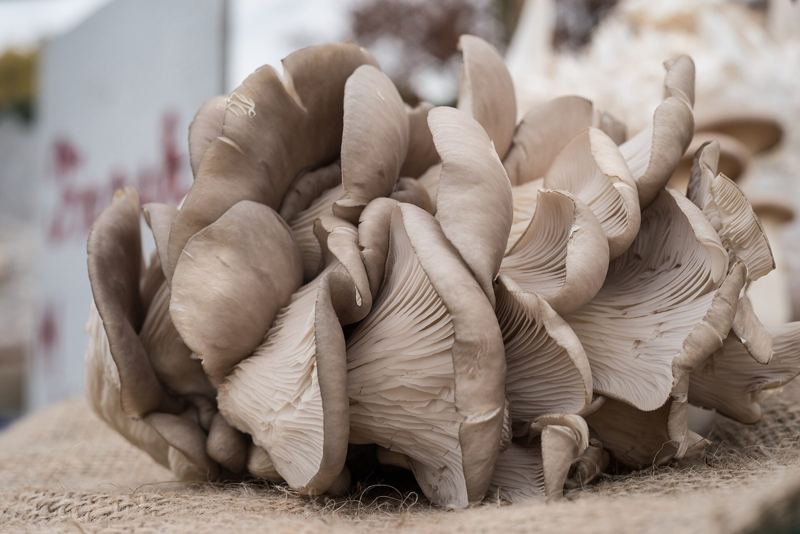
If the wait for logs is too long, oyster mushrooms fruit in weeks on straw or a kit. For the fundamentals behind both species, start with our how to grow mushrooms guide and the contamination guide.
Frequently asked questions
How long do shiitake logs take to produce mushrooms?
Cornell says shiitake logs take 6 to 18 months to incubate, and Maryland Extension agrees that logs begin to fruit 6 to 18 months after inoculation. The University of Wisconsin's guide says the logs start producing after about 12 months.
What is the best wood for shiitake logs?
Cornell lists oak, sugar maple, hop-hornbeam and musclewood as top-tier species, and says red and white oak perform about equally. Red maple, poplar, black locust, fruitwood and ash are widely known to be less suitable.
How long do I soak a shiitake log?
Cornell describes shocking as soaking logs in cold water for 12 to 24 hours to induce fruiting, and its forcing page says to submerge them for 24 hours. The University of Wisconsin says a 24-hour soak will stimulate mushrooms even more.
How long does a shiitake log keep producing?
Cornell says a log will continue to fruit biannually for three to four years, at upwards of 8 ounces per flush. Maryland Extension gives about three to five years of production.
Can you grow shiitake indoors?
Yes, on supplemented sawdust blocks, which Cornell says is what most specialty mushroom growers use as a fruiting substrate. That is commercial practice. We cover what our sources say in our guide to growing shiitake from sawdust blocks.
Sources
- Shiitake Mushroom Basics, Cornell Small Farms
- Seven Stages of Cultivation, Cornell Small Farms
- Inoculating Logs, Cornell Small Farms
- Forcing Bolts, Cornell Small Farms
- Shiitake Cultivation Best Management Practices, Cornell Small Farms
- Growing Mushrooms on Logs Using Sawdust Spawn, University of Wisconsin Extension, Forestry and Wildlife
- Shiitake Mushrooms (RES-11), University of Maryland Extension
 Oyster Mushroom