

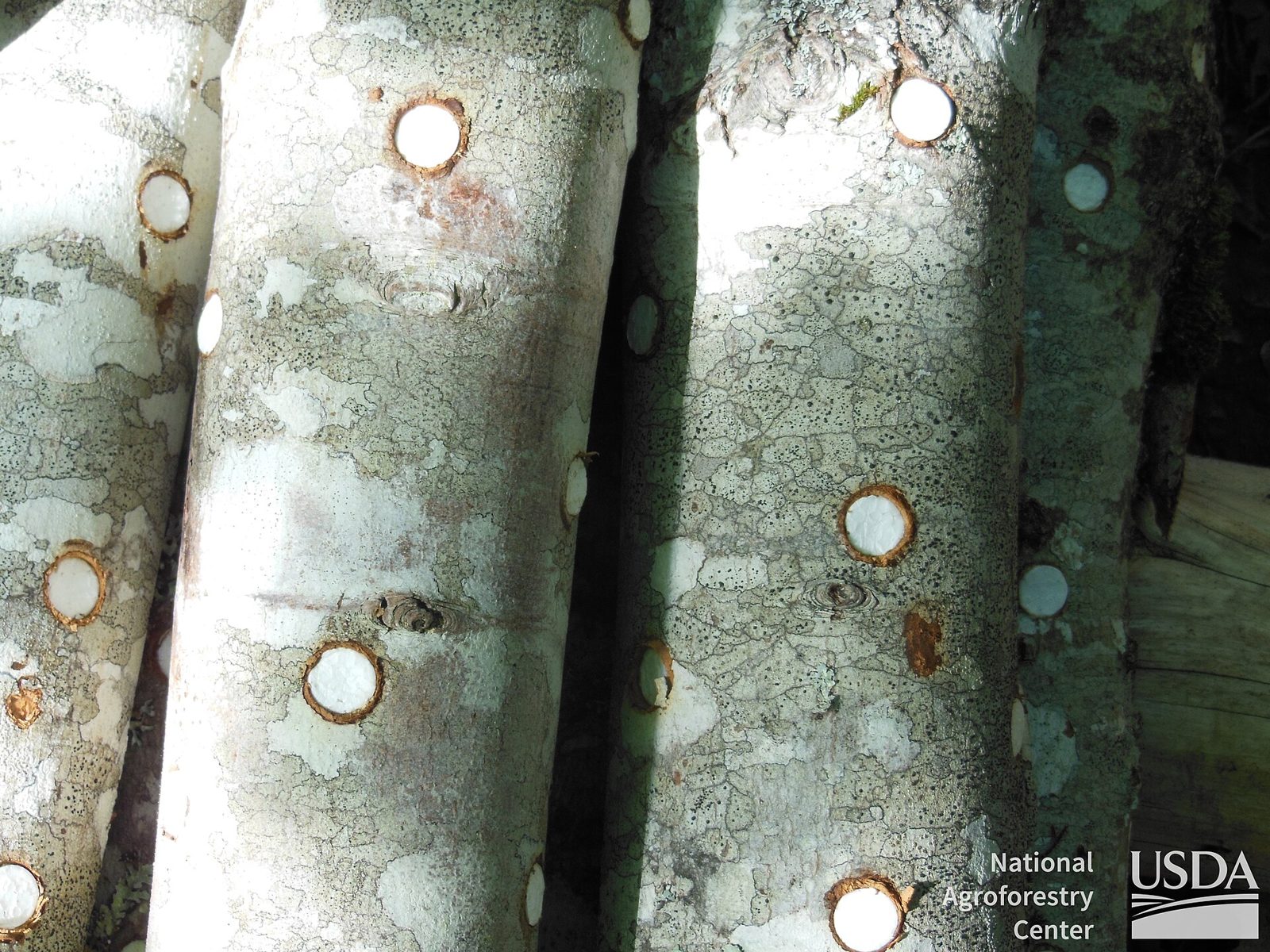
Shiitake logs are inoculated with spawn pressed into drilled holes in freshly cut hardwood, and the first mushrooms take 6 to 18 months to appear. This page covers the shiitake-specific details, from wood species to drilling spacing. For the species overview and the full cycle, see our shiitake growing guide, and for the general method that works across species, see our guide to growing mushrooms on logs.
Choose the wood
Cornell’s best management practices guide splits wood into good and poor choices:
- Top-tier: oak, sugar maple, hop-hornbeam and musclewood.
- Less suitable: red maple, poplar, black locust, fruit wood and ash.
- Oak notes: Cornell research found that red and white oak perform similarly as shiitake substrates. Oak and sugar maple take up water more slowly than hornbeam, which matters when you soak the logs later.
Use fresh-cut, live hardwood cut while the tree is dormant. Wisconsin’s size is 3 to 8 inches in diameter and 36 to 40 inches long. Winter and spring inoculations are ideal, according to Cornell, though summer and fall inoculations also produce sizable harvests. Winter-felled logs can be held for an early-spring inoculation.
Choose spawn
Cornell says spawn comes in three common forms: grain, sawdust and plug. For logs you will use the second or third. Plug spawn is very simple, needing only a drill and a hammer or mallet. Sawdust spawn is slightly cheaper but needs an inoculator tool, either bought or homemade. A per-log spawn amount is not in our sources, so follow your supplier. Our spawn guide explains the forms.
Drill, fill and wax
- Estimate the diameter. As a rule of thumb, Cornell says to drill as many rows of holes as the log has inches of diameter.
- Drill the rows. Start 1 inch from the end of the log and drill holes 3 inches apart in rows along its length.
- Insert the spawn. Hammer in plug spawn, or press in sawdust spawn with an inoculator.
- Seal with wax. Cover the surface of each hole with melted food-grade wax. Cornell says this gives the mycelium optimal growing conditions and reduces contamination by other fungi; Wisconsin says it prevents contamination and drying out.
Wait for the first fruiting
After inoculation the logs incubate. Cornell gives 6 to 18 months, and Maryland Extension says logs begin to fruit between 6 and 18 months after inoculation. The University of Wisconsin says that after about 12 months the logs start producing mushrooms. Cold-weather strains need a longer spawn run than other strains, according to Cornell.
Patience pays: Cornell reports that growers who waited longer before the first shock got significantly greater shiitake production. When you are ready, force the log by soaking it, and follow our shiitake harvesting guide. Cornell adds that logs fruit biannually for three to four years, at upwards of 8 ounces per flush, while Maryland puts production at about three to five years.
Log yields
In a Cornell trial, the average yield on logs varied from 0.5 to 2.3 pounds per log, with the strain LE-46 performing best. The range is wide, and it depends on strain, so do not treat it as a forecast. Cornell’s 8 ounces per flush is a better guide to what one flush can look like.
What our sources do not tell you
We found no drill-bit size or depth, no spawn quantity per log and no guidance on where to stack the logs beyond Cornell’s mention of a laying yard. Our log-size figures come from Wisconsin’s oak and mixed-hardwood guide. If your setup differs, use the extension’s numbers as a baseline. To compare the outdoor log method with a faster indoor route, see growing shiitake from sawdust blocks.
Frequently asked questions
How soon after cutting a log should I inoculate it?
Cornell says not to wait longer than three weeks, because the longer you wait the more likely the log is to be infested with competitive fungi or dry out. The University of Wisconsin says to let live, dormant logs rest away from sun and wind for two weeks before inoculating, so the two sources differ on whether to rest them.
How big should shiitake logs be?
The University of Wisconsin's guide uses hardwood logs 3 to 8 inches in diameter and 36 to 40 inches long.
Do I have to wax the holes?
Both Cornell and Wisconsin say to seal the holes with wax. Wisconsin says sealing is important to prevent contamination and drying out.
Plug spawn or sawdust spawn?
Cornell says plug spawn needs only a drill and a hammer or mallet. Sawdust spawn is slightly cheaper but needs an inoculator tool to insert it into the hole.
Sources
- Inoculating Logs, Cornell Small Farms
- Shiitake Cultivation Best Management Practices, Cornell Small Farms
- Growing Mushrooms on Logs Using Sawdust Spawn, University of Wisconsin Extension, Forestry and Wildlife
- Seven Stages of Cultivation, Cornell Small Farms
- Shiitake Mushrooms (RES-11), University of Maryland Extension