
Mushroom substrate is the material the mycelium feeds on, and the right one depends on the species: straw for oyster mushrooms, hardwood logs or sawdust for shiitake. Whatever you choose, it usually has to be heat-treated or otherwise cleaned before you add spawn, so that your fungus wins the race against everything else living in it. This guide covers substrates by species, the difference between pasteurizing and sterilizing, where our sources disagree, and supplements. It is the second stage in our guide to growing mushrooms, after spawn.
Substrates by species
| Species | Substrate | Source |
|---|---|---|
| Oyster | Wheat straw is the standard; also rice stalks, corn cobs, coffee grounds, cotton pulp, peanut shells, banana leaves and paper | UF/IFAS |
| Oyster | Straw, sawdust, crop residues and more | Cornell |
| Shiitake | Fresh-cut hardwood logs; supplemented sawdust blocks indoors | Cornell |
| Lion’s mane | Hardwood sawdust; a sawdust-based substrate is the usual route | Cornell |
Purdue lists wood, paper, grains, coffee waste and straw as general options for gourmet mushrooms. For shiitake logs, Cornell’s best-practice sheet names oak, sugar maple, hop-hornbeam and musclewood as top-tier species, and says red maple, poplar, black locust, fruit wood and ash are less suitable. See our log guide for the full log method.
Our sources do not give substrate lists for every species. The ones above are what we can source.
Pasteurizing versus sterilizing
Our sources use the two words for different treatments, so we keep them apart.
- Pasteurizing in our sources means a heat or chemical treatment for straw: a hot water bath, steam or a lime bath (UF, Cornell, Purdue).
- Sterilizing in our sources means autoclave, steam room or boiling for substrate (Cornell), pressure canners or autoclaves for bags (Illinois), and a pressure cooker for grain spawn, in general 30 minutes at 15 psi (UF).
The details follow.
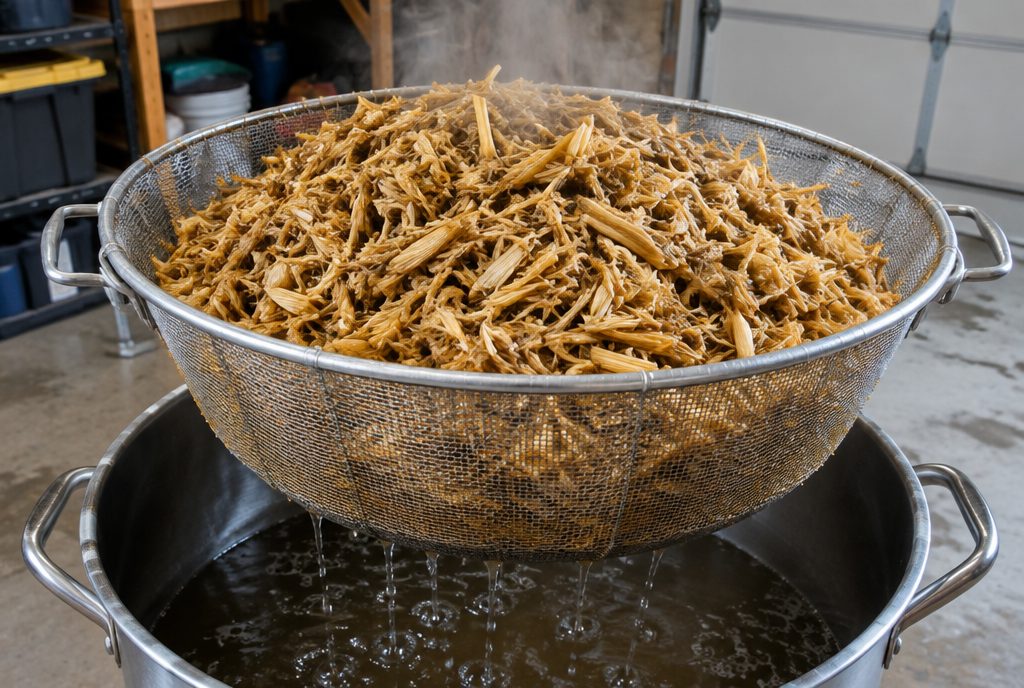
UF/IFAS (straw, oyster). Cut straw into 4 to 5 inch pieces and soak it overnight. Then pasteurize by keeping it at 165°F (74°C) in a water bath for 1 to 2 hours. UF names steam or a hydrated lime bath as alternatives. This is the only single temperature and time for straw in our sources.
Illinois Extension (block bags, commercial). It describes block bags that are pasteurized at high temperatures, typically under pressure, for several hours. That is a commercial method, not a home one.
Lime pasteurization. Purdue says lime pasteurization is a more economical method, in time and funds, that uses a pH change instead of heat. In a Cornell trial, straw was soaked in a hydrated mason lime solution and then neutralized to pH 7 to 8 with citric acid. We do not give a home recipe for it, because the trial figures we hold are not a complete method.
Where the sources disagree
Cornell’s own pages conflict on whether straw must be sterilized or only pasteurized.
| Source | What it says |
|---|---|
| Cornell, DIY substrates | Whether you use straw or sawdust, you must sterilize it before inoculating. Sterilization can be done with an autoclave, a steam room, or by boiling before adding spawn |
| Cornell, Four Methods and Seven Stages | Low-nutrient straw can be pasteurized or lime-soaked and inoculated outdoors |
| UF/IFAS | Pasteurize straw at 165°F for 1 to 2 hours; steam and lime are alternatives |
Our reading is that the pages may describe different settings, since the DIY page is aimed at small growers and the others at commercial outdoor straw, but they do not say so. None of the sources tests one method against the other, so we cannot say which is better. UF is the only source that gives a full home-scale straw protocol, and clean working habits matter either way; see our contamination guide.
Preparing straw
Two preparation steps appear in the sources.
- Cut it. UF cuts straw into 4 to 5 inch pieces and soaks it overnight.
- Shred it. Cornell says yields can substantially increase when material is shredded before cleaning the substrate and inoculating.
After treatment, UF adds spawn to the pasteurized straw at 5 to 10%. That rate is UF’s, for oyster on straw only; see mushroom spawn.
Straw is easy to keep before use. Cornell says it is baled in compressed 40 lb bales, or larger, that store easily. Our sources give no storage advice for treated substrate, so treat it as use-immediately.
Supplements
Cornell calls soybean hulls a nitrogen amendment for straw. We only state what our sources show.
- Cornell trial. Straw mixed with half a pound of dry soybean hulls, as a nitrogen amendment, per 10 lb of damp straw. In one Cornell trial, oyster bags amended with soybean hulls averaged about twice the yield of unamended bags.
- Illinois Extension. Block bag supplements typically consist of soybean hull pellets, alfalfa, coffee grounds or others.
That is a relative result from one trial, not an absolute yield. Our sources give no biological efficiency figure for oyster, and supplement rates for other species are not sourced here.
Indoors or outdoors
Cornell says oyster straw can be inoculated outdoors with little contamination concern, but that fruiting is best done indoors. It also says outdoor straw gets insect larvae. UF’s pasteurized straw is fruited in a chamber held at about 90% humidity. If you work outdoors, expect pests to be part of the picture.
A short decision list
- Oyster on straw: cut, soak overnight, hold at 165°F (74°C) for 1 to 2 hours (UF), then spawn at 5 to 10%.
- Shiitake on logs: no heat treatment step in our sources; use fresh-cut hardwood and inoculate within three weeks of felling (Cornell).
- Lion’s mane, shiitake indoors: supplemented hardwood sawdust. Cornell says sawdust must be sterilized before inoculating, and Illinois describes block bags pasteurized under pressure for several hours. Both are commercial-scale descriptions, so check the scale before copying a schedule.
- Any species: if two sources disagree on treatment, say which setting each is written for before choosing.
Reading a substrate recipe
When you see a substrate recipe online or on a package, check four things against our sources. Is the material one the species is known to use? Is it heat-treated, and is that pasteurizing or sterilizing? Does it add a supplement, and is the amount stated as a weight ratio, as Cornell’s trial does? And is it written for commercial blocks or for home buckets? A recipe that answers none of these is hard to trust, because the treatment and the scale change the numbers that apply to you.
Commercial versus home
Several of our sources describe commercial operations: Illinois block farming, Cornell’s northeastern commercial cultivation series, Purdue’s gourmet production notes. UF’s SS662 oyster protocol is a home-scale method. Where the two differ, as with the sterilizing-or-pasteurizing question, we show both and say which setting each is written for. When you are ready to match a substrate to a species, our oyster and shiitake pages list conditions for each stage.
Frequently asked questions
What is the best substrate for mushrooms?
It depends on the species. UF calls wheat straw the standard substrate for oyster mushrooms, and Cornell says shiitake, lion's mane and others do best on sawdust. Shiitake also grows on fresh-cut hardwood logs, with oak, sugar maple, hop-hornbeam and musclewood top-tier (Cornell).
Do I need to pasteurize or sterilize straw for mushrooms?
Sources differ. UF pasteurizes straw at 165°F (74°C) in a water bath for 1 to 2 hours. Cornell's DIY page says to sterilize straw or sawdust before inoculating, by boiling, steam or autoclave, while other Cornell pages say low-nutrient straw can be pasteurized or lime-soaked and inoculated outdoors.
How do you pasteurize straw for oyster mushrooms?
UF's method is to cut straw into 4 to 5 inch pieces, soak it overnight, then hold it at 165°F in a water bath for 1 to 2 hours. UF also lists steam or a hydrated lime bath as alternatives.
Do mushroom substrates need supplements?
Not always. In one Cornell trial, straw mixed with half a pound of dry soybean hulls per 10 lb of damp straw gave about twice the yield of unamended bags. Illinois Extension names soybean hull pellets, alfalfa and coffee grounds as common supplements for block bags.
Sources
- Oyster Mushroom Cultivation (SS662), University of Florida IFAS Extension
- The Science of DIY Mushroom Substrates, Cornell Small Farms
- Four Methods of Commercial Cultivation, Cornell Small Farms
- Block Farming, University of Illinois Extension
- Growing Gourmet Mushrooms, Purdue Extension
- Shiitake Cultivation Best Management Practices, Cornell Small Farms