
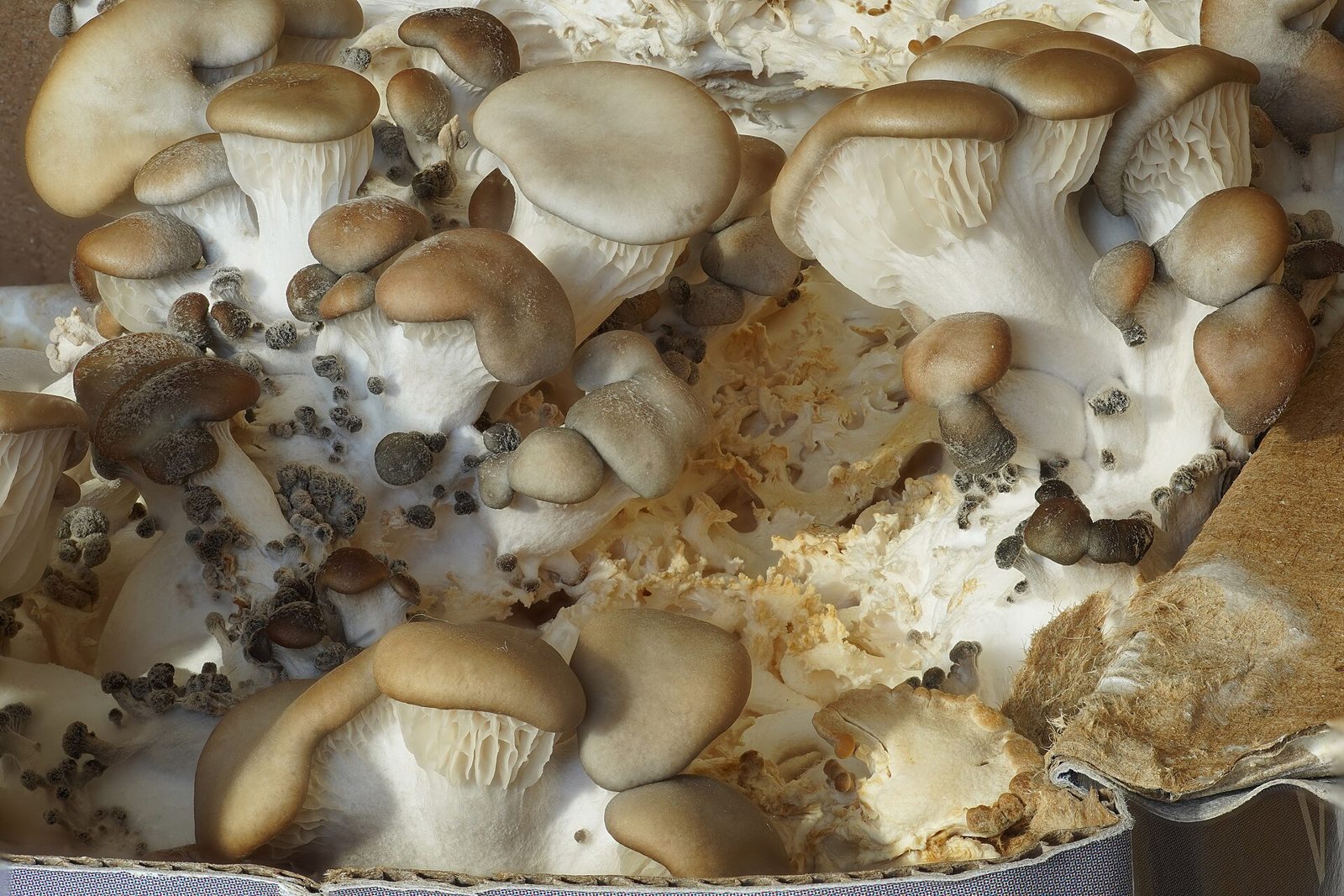
Harvest oyster mushrooms when the cap is still curled under, and before it flattens and drops spores. Twist and gently pull the cluster, or cut it flush with the substrate using a knife. Then keep the block misted and ventilated, because there should be two to four more flushes. This page is a companion to our main oyster mushroom growing guide.
How to tell when they are ready
Cornell’s advice in its DIY substrate article is short: you want to harvest when the mushroom cap is still curled under. As oysters mature the edges flatten out, and flat caps are less palatable. Spores also begin to drop, so the window for picking is before the caps open fully. Our sources do not give a day count or a size, so judge by the cap edge, not the calendar.
For reference, Cornell’s commercial straw cycle runs about five weeks from inoculation to harvest. The University of Florida’s home guide has the fruiting stage starting around three weeks after the bags go into the dark. Either way, the clusters grow quickly once pins form, so check them often.
How to pick
- Check the caps. Look for caps whose edges are still curled under, and pick before they flatten and drop spores.
- Twist or cut. UF/IFAS describes two ways. You can twist and gently pull the cluster off, or cut it flush with the substrate with a knife.
- Keep the block moist. Wisconsin’s bucket guide says to keep spraying the container with water and harvesting mature mushrooms over the next four weeks, or until the bucket stops producing.
- Wait for the next flush. UF/IFAS says to expect two to four more flushes after the first, depending on the fungal strain and the ambient environment.
Harvest at a glance
| Question | Answer from our sources |
|---|---|
| When to pick | Cap still curled under, before spores drop (Cornell) |
| How to pick | Twist and gently pull, or cut flush with a knife (UF) |
| More flushes | 2–4 after the first (UF) |
| Bucket method | Keep misting and harvesting about 4 weeks (Wisconsin) |
| How long they keep | Not stated in our sources |
What changes between flushes
UF’s fruiting conditions are light, a lower temperature of about 20°C (68°F), humidity near 90% and good air exchange to avoid CO2 build-up. Cornell’s fruiting room held 85%. Our sources do not describe separate conditions between flushes. Light is not just a trigger. Cornell says there is a growing body of literature that the color and intensity of light in a grow room affects the structure, size, color and chemistry of the mushrooms, so the same block can look different under different lighting.
Getting more from each block
Yield figures are thin in our sources. Cornell reports one relative result: in a DIY trial, bags amended with soybean hulls averaged about twice the yield of unamended bags. Its recipe was half a pound of dry soybean hulls per 10 pounds of damp straw. It is a single trial and not a promise for your setup, but it is the only sourced way to raise yield we have. Illinois Extension lists soybean hull pellets, alfalfa and coffee grounds as common supplements for commercial blocks. Our substrate guide explains the supplements.
If a flush looks smaller than the last one, or a bag starts to show green or yellow spots, check it for contamination before assuming it is spent. UF says that heavily contaminated bags are best removed and discarded. Our mushroom contamination guide helps with the diagnosis.
What our sources do not tell you
We found no storage time for fresh oysters, no absolute yield per bag or bucket, and no size or weight guide for when a cluster is ready. Cornell’s five-week cycle is commercial. If you are working from a kit, the oyster kit guide covers what the kit needs, and growing in buckets or bags covers the container methods. When you want a second species, shiitake harvesting follows a very different, log-based rhythm.
Frequently asked questions
How do I know an oyster mushroom is ready to pick?
Cornell says to harvest when the cap is still curled under, before spores drop. Flat caps are less palatable.
Should I twist or cut oyster mushrooms?
UF/IFAS says clusters are harvested either by twisting and gently pulling or by cutting flush with the substrate with a knife. Both are accepted.
Will the same block fruit again?
Yes. UF/IFAS says that after the first flush there should be two to four more flushes, depending on the strain and the ambient environment.
How long can I keep fresh oyster mushrooms?
Our extension sources do not give a storage time for oysters, so we do not state one.
Sources
- The Science of DIY Mushroom Substrates, Cornell Small Farms
- D.I.Y. FunGuide: Grow Your Own Oyster Mushrooms at Home (SL448/SS662), University of Florida IFAS Extension
- Growing Mushrooms in Buckets, University of Wisconsin Extension, Forestry and Wildlife
- Block Farming, University of Illinois Extension
- Four Methods of Commercial Cultivation, Cornell Small Farms