

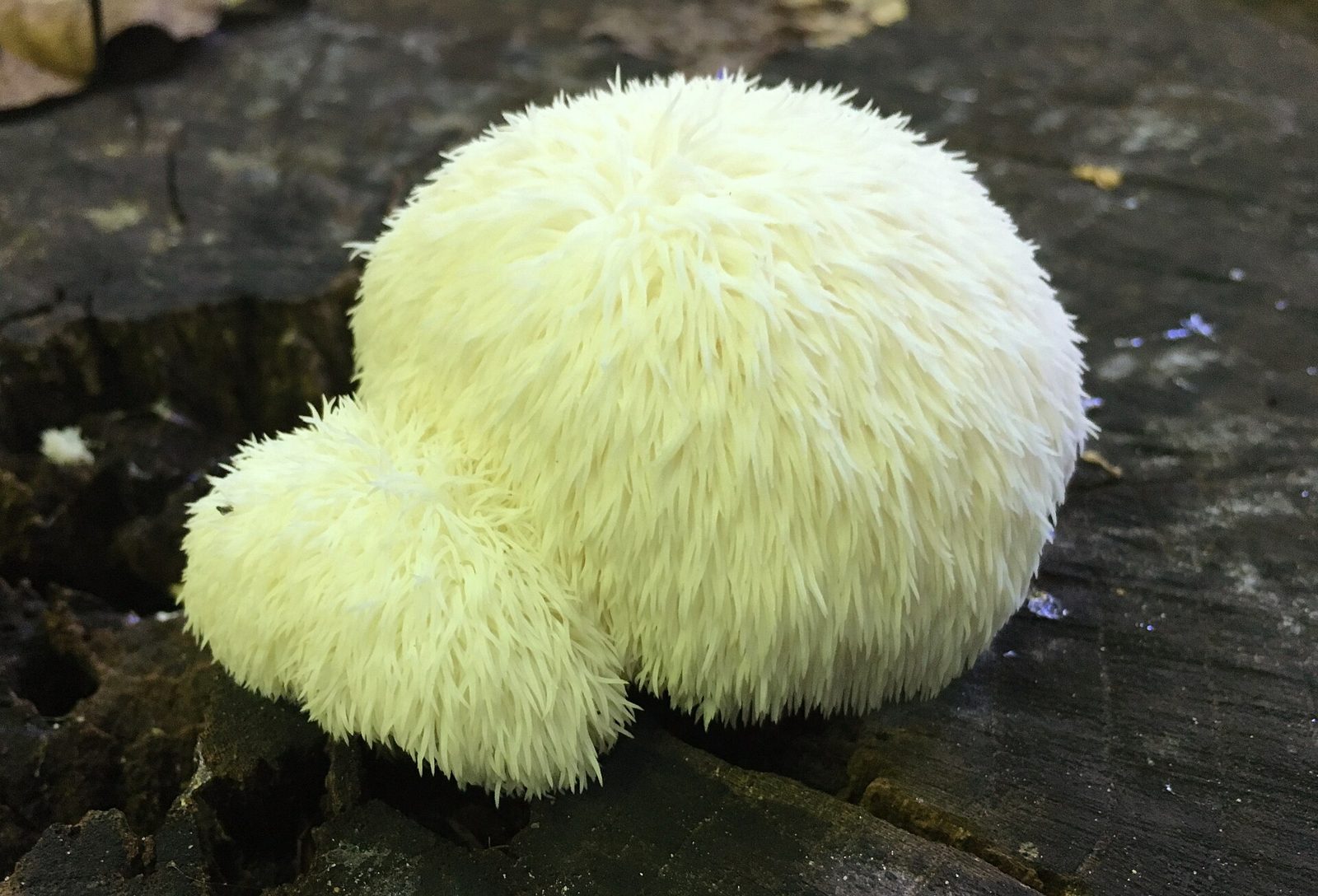
Harvest lion’s mane when the teeth are about 1 cm (0.4 in) long and drooping downward. That is Cornell’s cue, and it is the one harvest sign our extension sources give for this species. Lion’s mane also keeps less well than shiitake, so pick it when you are ready to use it. This page is part of our lion’s mane growing guide, where the whole cycle is laid out.
How to tell when it is ready
Lion’s mane is the mushroom with the shaggy white spines, and those spines, which Cornell calls teeth, are the thing to watch. Cornell says to harvest “when teeth are about 1cm long and drooping downward.” Check the length first, then the direction.
Our sources give no photo-based guide to lion’s mane colors or textures, and none describe what happens if you wait too long. We would rather say that than invent a warning sign. If your kit’s maker gives its own cue, put it next to Cornell’s and use whichever is more conservative.
How long it takes to get there
No extension source we found gives a days-to-harvest figure for lion’s mane. In one university trial in Thailand, growing on rubber-tree sawdust in bottles, mushrooms were harvested 47 days after spawning. That bottle trial is the only timing we have, so do not plan a calendar around 47 days. A kit that arrives colonized starts later in the process, and your own room will differ.
| Stage | Days | Humidity | Notes |
|---|---|---|---|
| Fruiting before harvest | Not stated | 90% | Purdue: increase to 90% humidity when mushrooms begin to pin and fruit, but water trapped between the spines can distort them. The Thai trial held 65–75%. |
| Harvest | 47 days | Not stated | 47 days after spawning in the Thai trial. Cornell: teeth about 1 cm (0.4 in) long and drooping downward. |
Keep water out of the spines before you pick
Purdue says lion’s mane needs high humidity at certain stages, but water trapped between the spines can lead to distorted mushrooms. It also says that watering practices can affect the fruiting body. The practical reading is to raise humidity in the air around the block rather than spraying the mushroom itself.
What a harvest can weigh
Yield depends on the substrate and the set-up, and the only figures we have come from the Thai trial. In that study the best result came from 100% rubber-tree sawdust: a fresh yield of 113.22 g (about 4 oz), a dry weight of 23.25 g and a biological efficiency of 42.61%. A 3:1 mix of rubber and bamboo sawdust gave a comparable yield, and yield fell as the share of bamboo rose.
Treat 113 g as a sense of scale for one bottle-grown trial, not as what a home kit will give you. Our sources do not give a yield for a retail kit or for a home sawdust block.
Storing lion’s mane
Storage is one of the thinner parts of our research.
- Fresh: Cornell says shiitake tend to have a better shelf life than oyster or lion’s mane, so lion’s mane is among the shorter-lived. Cornell’s general advice for harvested specialty mushrooms is 34–37°F (1–3°C) for about 7 days. That figure is general, not specific to lion’s mane, so use it as an upper limit and plan to cook early.
- Dried: the University of Kentucky says many specialty mushrooms can be dried to extend shelf life by 6 to 12 months, but that this is not commonly done with lion’s mane. No drying method for lion’s mane is given.
- Frozen or cooked: no source we found covers freezing or cooking lion’s mane, so we do not give instructions.
After the harvest
Our sources do not say how many flushes lion’s mane gives or whether a block can be rested and reused. Your kit’s instructions are the best guide. For oyster, which is better documented, UF/IFAS expects two to four more flushes, and our oyster harvesting guide describes how that works. For the first-time setup, see how to fruit a lion’s mane kit.
What our sources do not tell you
We found no extension source for what lion’s mane looks like when it is over-mature, how to pick it (cutting versus twisting), how many flushes to expect, or a lion’s-mane-specific storage time. The 47 days and the yield come from a single trial in Thailand. We prefer to leave those gaps visible than to fill them.
If you want an outdoor project next, wine cap grows outdoors in garden beds from purchased spawn. For the fundamentals behind all of them, see our how to grow mushrooms guide.
Frequently asked questions
How do I know when lion's mane is ready to harvest?
Cornell says to harvest when the teeth, the hanging spines, are about 1 cm (0.4 in) long and drooping downward.
How long does fresh lion's mane keep?
Cornell says shiitake have a better shelf life than oyster or lion's mane, so lion's mane is on the shorter side. Its general storage advice for harvested mushrooms is 34–37°F (1–3°C) for about 7 days, but that is not specific to lion's mane.
Can I dry lion's mane?
The University of Kentucky says drying can extend shelf life by 6 to 12 months for many specialty mushrooms, but notes it is not commonly done with lion's mane. It gives no method for lion's mane, so check what works before relying on it.
How big a harvest should I expect?
It depends heavily on substrate and set-up. In one university trial in Thailand, on rubber-tree sawdust in bottles, the best fresh yield was 113.22 g. That is one study's figure, not a typical home result.
Sources
- Harvest to Market: Specialty Mushroom Production, Cornell Small Farms
- Seven Stages of Cultivation, Cornell Small Farms
- Gourmet and Medicinal Mushrooms (CCD-CP-079), University of Kentucky Center for Crop Diversification
- Growing Gourmet Mushrooms, Purdue Extension
- Cultivation of Hericium erinaceus (Yamabushitake) on rubber and bamboo sawdust, Peer-reviewed trial in Thailand (PMC10432537)