
Growing mushrooms on logs means drilling holes in freshly cut hardwood, filling them with spawn, sealing them with wax, and waiting 6 to 18 months for the first mushrooms. After that a log keeps producing for years. It is the slowest of the three beginner routes in our guide to growing mushrooms, and the one with the least day-to-day work. Our log sources are about shiitake, so the numbers below are shiitake numbers. Our shiitake on logs page has the species-specific detail, and the shiitake pillar has the rest.
Which trees work
For shiitake, Cornell’s best-practice sheet names oak, sugar maple, hop-hornbeam and musclewood as top-tier species. It says red maple, poplar, black locust, fruit wood and ash are widely known to be less suitable. Cornell research found red and white oak perform about equally.
Cornell says to cut live, dormant logs. Our sources do not list log species for other mushrooms. Cornell does note that lion’s mane is one of the species studied for log cultivation in its research, but gives no log recipe for it, so we do not either.
When to cut
Winter and spring inoculations are ideal (Cornell), although Cornell says summer and fall inoculations also produce sizable harvests. Winter-felled logs can be held for early-spring inoculation.
The two main sources disagree on how long a log should rest between cutting and inoculating.
| Source | Advice |
|---|---|
| Cornell | Do not wait longer than three weeks to inoculate; the longer you wait, the more likely the log is infested with competing fungi or has dried out |
| Wisconsin | Cut live, dormant logs and let them rest away from sun and wind for two weeks before inoculating |
These are not quite opposites. Wisconsin gives a minimum rest and Cornell gives a maximum wait, so inoculating between two and three weeks after cutting fits both. That window is our reading, not a quoted recommendation from either source.
Log size
Wisconsin recommends a hardwood log 3 to 8 inches in diameter and 36 to 40 inches long. Cornell uses diameter to set the number of drill rows: as many rows as the log has inches of diameter.
Inoculating
Both Cornell and Wisconsin use sawdust spawn or plug spawn in drilled holes. Cornell says sawdust spawn goes in with an inoculator and plug spawn is hammered in. Our spawn guide compares the forms.
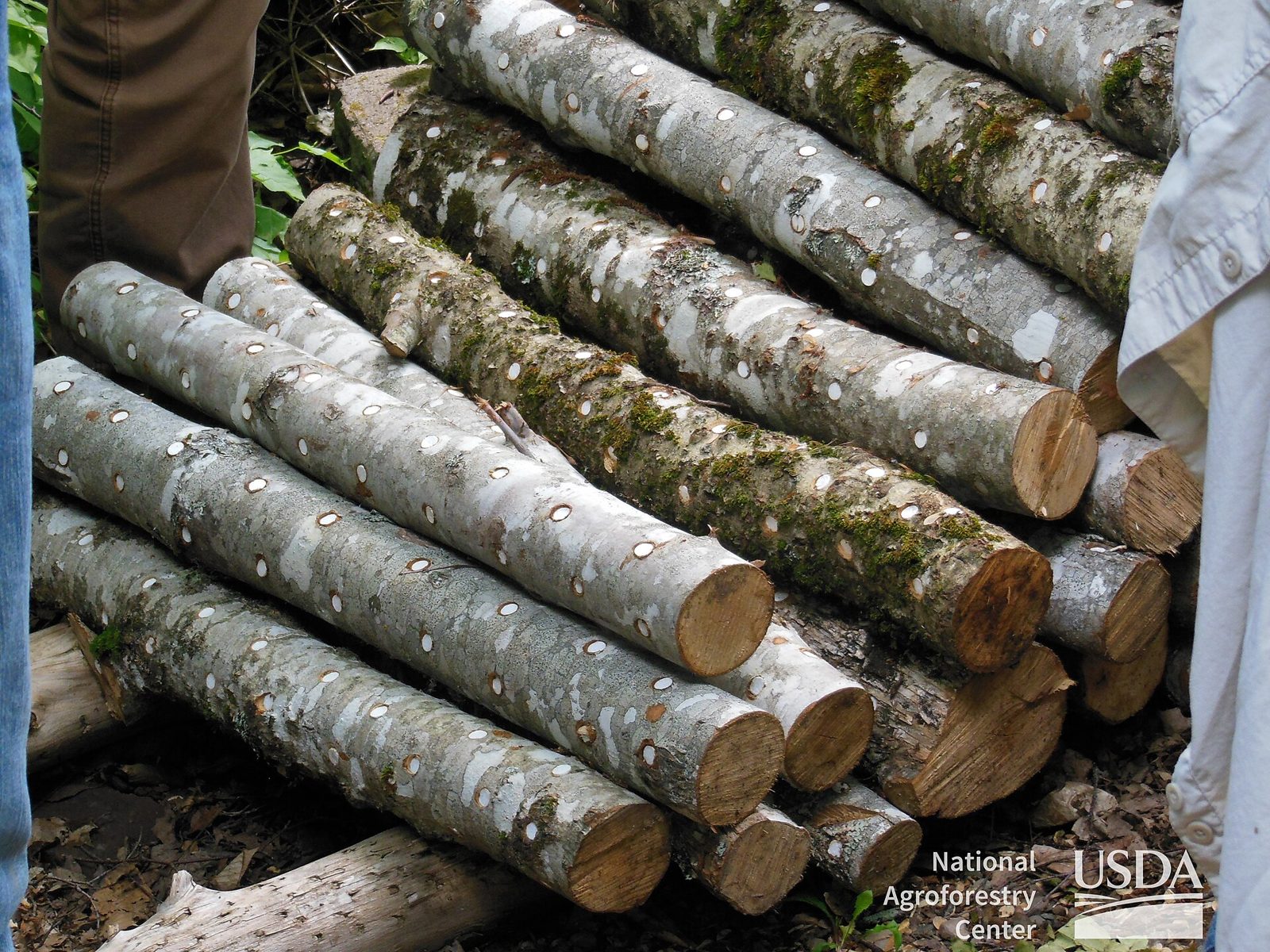
- Drill the holes. Cornell says to start 1 inch from the end of the log and drill holes 3 inches apart in rows along its length, with as many rows as the log has inches of diameter.
- Fill them with spawn. Insert sawdust or plug spawn into each hole. Our sources give no spawn rate per log.
- Seal each hole with wax. Melt food-grade wax and cover each filled hole. Wisconsin says sealing is important to prevent contamination and drying out. Cornell says it reduces contamination by other fungi.
- Stack and wait. Cornell describes outdoor production in a laying yard for the logs’ whole productive life. Our sources give no stacking pattern, so we do not describe one.
Cornell stresses the stage between cutting and inoculating because that is when competing fungi get in. It is a good example of why contamination control matters even outdoors.
Choosing a strain
Cornell sorts shiitake strains into three groups: Wide Range (WR), Warm Weather (WW) and Cold-Weather (CW). It calls Wide Range the easiest for beginners. Cold-weather strains fruit in early spring and late fall and need a longer spawn run, while warm-weather strains produce best in hot summer months and early fall. Your strain therefore sets when you can expect mushrooms, so check which one your spawn is before planning the first soak.
Incubation and first fruiting
The mycelium spreads through the log before it can fruit. Cornell gives 6 to 18 months for shiitake logs to incubate, and Maryland Extension says logs begin fruiting between 6 and 18 months after inoculation. Wisconsin says the logs start producing mushrooms after about 12 months.
Cornell also says growers who waited longer before the first shock, or soak, were rewarded with significantly greater shiitake production. Patience is part of the method.
Shocking and fruiting
Shiitake logs are encouraged to fruit by soaking them in cold water, called shocking. Cornell says to soak logs for 12 to 24 hours, and Wisconsin says a 24-hour soak stimulates even more mushrooms. Cornell says night temperatures should average above 50°F before logs are shocked.
| Detail | Figure | Source |
|---|---|---|
| Soak | 12 to 24 hours (Cornell); 24 hours (Wisconsin) | Cornell, Wisconsin |
| Night temperature before soaking | Average above 50°F | Cornell |
| Pins after soaking | 3 to 5 days | Cornell |
| Rest between forcings | 6 to 8 weeks | Cornell |
| Yield | About 8 oz per flush | Cornell |
Cornell describes pins as bumps about the size of a pencil eraser, and says to protect them from rain for 2 to 3 days before picking. Maryland says to harvest when caps are about two-thirds open.
How long logs last
Cornell says the log will continue to fruit twice a year for three to four years, generating upwards of 8 ounces of mushrooms at each flush. Maryland’s older sheet says about three to five years of production. The two figures overlap, so plan on at least three years.
A timeline from cut to harvest
| When | What happens | Source |
|---|---|---|
| Winter or spring | Cut live, dormant logs and inoculate (ideal seasons) | Cornell |
| Within about three weeks of cutting | Inoculate (Wisconsin adds a two-week rest first) | Cornell, Wisconsin |
| 6 to 18 months later | Logs begin fruiting; about 12 months in Wisconsin’s guide | Cornell, Maryland, Wisconsin |
| When night temperatures average above 50°F | Soak 12 to 24 hours | Cornell |
| 3 to 5 days after the soak | Pins appear | Cornell |
| 6 to 8 weeks between forcings | Logs rest | Cornell |
| After first fruiting | Fruiting twice a year for three to four years (Cornell) or three to five (Maryland) | Cornell, Maryland |
Pests and problems
Cornell lists slugs, chipmunks and pleasing fungus beetles as damaging pins, and says competing fungi reduce flush size. Our sources give no treatment, so we do not offer one.
Reishi on logs
Shiitake is not the only log mushroom. The University of Kentucky says maitake, reishi and lion’s mane can be cultivated on logs in the same manner as shiitake. For reishi, Oregon State Extension gives 2- to 4-foot hardwood logs 4 to 7 inches across, inoculated with sawdust spawn within 30 days of cutting and sealed with food-grade wax. It says reishi is slower to form mature mushrooms than shiitake, oyster or lion’s mane. See how to grow reishi for the log steps and the timings.
Why logs suit patient growers
The log route trades speed for low effort. Once the logs are drilled, filled and waxed, the work is a soak every few months for years, rather than the daily misting a fruiting bucket needs. The cost is the first wait: 6 to 18 months before any mushrooms (Cornell, Maryland). If you want a harvest this season, a kit or a straw bucket is the faster way to find out whether you enjoy growing mushrooms, and logs can follow.
Commercial versus home
Much of Cornell’s material describes a commercial laying yard and the yield figures come from grower trials. A home grower with a few logs should read those as guides, not guarantees. Wisconsin’s guide is written for small-scale oak and mixed-hardwood logs, and its numbers are the closest to a backyard setup.
Frequently asked questions
How long does it take to grow mushrooms on logs?
Cornell gives 6 to 18 months for shiitake logs to incubate, and Maryland Extension says logs begin fruiting 6 to 18 months after inoculation. Wisconsin says the logs start producing mushrooms after about 12 months.
What is the best wood for growing mushrooms on logs?
For shiitake, Cornell's best-practice sheet names oak, sugar maple, hop-hornbeam and musclewood as top-tier, and says red maple, poplar, black locust, fruit wood and ash are less suitable. Cornell research found red and white oak perform about equally.
How soon after cutting should you inoculate a log?
Sources differ. Cornell says not to wait longer than three weeks after felling. Wisconsin says to let live, dormant logs rest away from sun and wind for two weeks before inoculating.
How long do mushroom logs keep producing?
Cornell says a shiitake log fruits twice a year for three to four years, with upwards of 8 ounces per flush. Maryland Extension says logs produce for about three to five years.
Sources
- Shiitake Cultivation Best Management Practices, Cornell Small Farms
- Inoculating Logs, Cornell Small Farms
- Forcing Bolts, Cornell Small Farms
- Shiitake Mushroom Basics, Cornell Small Farms
- Seven Stages of Cultivation, Cornell Small Farms
- Mushrooms on Logs Using Sawdust Spawn, University of Wisconsin Extension Forestry
- Shiitake Mushroom Production (RES-11), University of Maryland Extension