
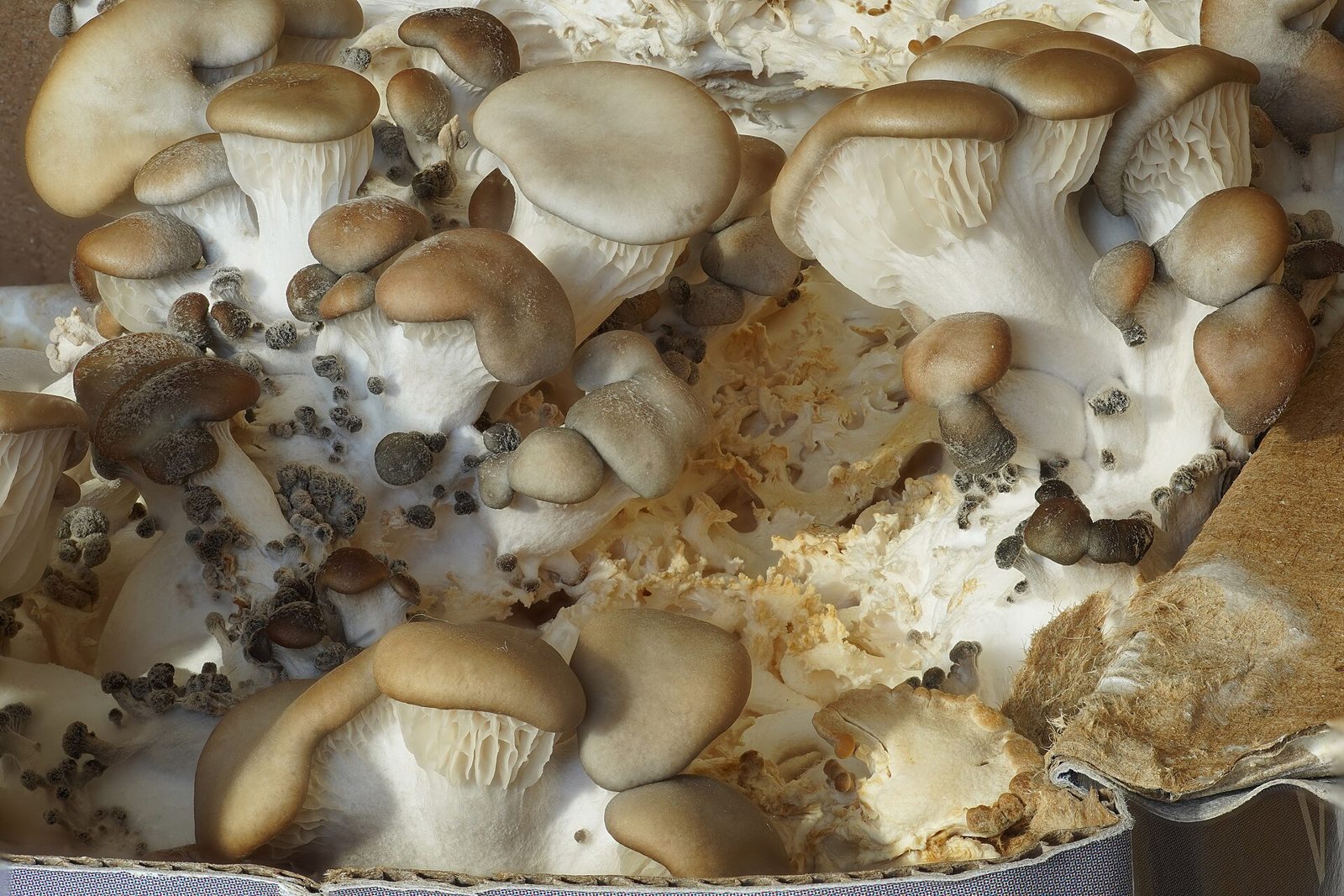
A mushroom grow kit is a container of substrate that is already colonized with mycelium, so you skip the slow stages and go straight to fruiting. That is why kits are the lowest-effort way to grow mushrooms at home: UF/IFAS describes the kit route as setting up a ready-made, already colonized kit in a suitable fruiting environment. You supply the place, the humidity and the patience. This guide explains what a kit is, how to start one, how many flushes to expect and what can go wrong. It sits inside our wider guide to growing mushrooms.
What a kit is
Every mushroom crop passes through four stages: spawn, substrate, colonization, fruiting. A kit hands you the container after colonization. Someone else has mixed the spawn into the substrate and let the mycelium run through it, so what you receive is a block or bag of substrate that is mostly mycelium.
Our sources do not describe a retail kit in detail, so we separate what they do say:
- UF/IFAS treats a ready-made, already colonized kit as one of the ways to start oyster cultivation. Its other route is to build your own from three components: healthy spawn, pasteurized substrate and containers.
- Illinois Extension describes commercial block substrate, not retail kits. Its bags have built-in micron filters that allow oxygen and CO2 exchange. That tells you what the filter patch on many bags is for, but it is a description of grower blocks, so treat it as background.
- Wisconsin Extension describes a do-it-yourself bucket of wood chips and grain spawn. It is the closest fetched source to starting a kit-like container at home.
Our sources give no shelf life or storage method for a kit, so we do not state one. Read the instructions that come with yours.
How to start a kit
Your kit’s own instructions come first, because kits differ. The steps below are the common thread from our sources.
- Choose a place. Wisconsin recommends a spot at about room temperature, 65 to 75°F (18 to 24°C), away from sunlight, for its bucket. It then leaves the bucket undisturbed for about 14 days.
- Wait for pins. Pins are the first tiny mushroom bumps. In Wisconsin’s method, once pins have started you remove the bag.
- Hold humidity high. Wisconsin has you spray the outside of the bucket with water to maintain high humidity. UF’s oyster fruiting chamber holds about 90% humidity with humidifiers or foggers, which is a grower setup rather than a typical home one.
- Give it air. UF says fruiting needs good air exchange so CO2 does not build up while humidity stays high.
- Harvest, then keep going. Harvest the mature mushrooms and keep misting. Wisconsin says to continue for about four weeks or until the container stops producing.
For the harvest itself, Cornell says to pick oyster mushrooms while the cap is still curled under and before spores drop, because flat caps are less palatable. UF says to twist and pull or cut them flush with the substrate.
Flushes
A flush is one wave of mushrooms. UF says that after the first flush there should be 2 to 4 more, depending on the fungal strain and the ambient environment. Wisconsin’s bucket gives about four weeks of misting and harvesting.
| Source | What it says about repeat harvests |
|---|---|
| UF/IFAS | 2 to 4 more flushes after the first, depending on strain and environment |
| Wisconsin Extension | Keep misting and harvesting for about 4 weeks, or until the bucket stops producing |
These are not the same claim. UF counts flushes and Wisconsin counts weeks, and neither is a promise for a particular retail kit. Treat the yield of your own kit as the real answer. Our sources give no absolute yield figure, only a relative one in a Cornell trial where soybean-hull-amended oyster bags gave about twice the yield of unamended bags.
What triggers fruiting
For oyster mushrooms, UF says fruiting is triggered by light plus a lower temperature, with about 20°C (68°F) given as the trigger. Cornell adds that light colour and intensity affect the shape and colour of the mushrooms. Humidity runs high through fruiting: UF gives about 90% and Cornell’s fruiting room held 85%.
| Stage | Temperature | Humidity | Light | Fresh air |
|---|---|---|---|---|
| Fruiting | 68°F (20°C) | 85–90% | Light plus lower temperature | Good air exchange to avoid CO2 buildup |
These are oyster figures from grower setups, so a kit for another species may ask for different conditions. Our sources give no kit-specific fruiting numbers for lion’s mane or shiitake kits. Lion’s mane guidance from Purdue is for indoor cultivation, with about 90% humidity once pinning begins and no water left trapped between the spines, which distorts the mushrooms. Purdue’s fresh-air advice is general gourmet guidance, not specific to lion’s mane.
What can go wrong
Contamination. UF says to look closely at bags for blue, green, black or yellow spots. Trichoderma, one of the common contaminants, shows as rapid greenish growth. UF adds that contaminated bags, especially heavily contaminated ones, are best removed and discarded. Our contamination guide explains why this happens and how growers prevent it.
Pests. UF says insects and rodents should be kept off bags.
Dry or stalled fruiting. Wisconsin’s answer to dryness is the humidity step: keep spraying the outside of the container. Our sources give no further troubleshooting for kits, so we do not offer any.
Too little air. If humidity is high but there is no air exchange, UF warns of CO2 building up in the chamber.
Questions to answer before you set one up
- Which species is it? Conditions differ by species, so look up the one on your kit.
- Where will it sit? A spot at room temperature, away from sunlight, with a way to hold humidity, as in Wisconsin’s bucket method.
- How will you provide air? Air exchange matters as much as humidity (UF).
- What will you do about a spotted bag? Decide in advance. UF’s advice is to discard heavily contaminated bags rather than try to rescue them.
Setting expectations
A kit gets you to fruiting quickly, but it does not remove the need for attention. The fruiting conditions in our sources, humidity near 85 to 90%, air exchange and a cooler trigger, are the same ones a grower building from scratch has to meet. Our sources give no absolute yield for a kit, so judge your first flush against how the later flushes do. Keep notes on where the kit sat and how often you misted it, and you will know what to repeat or change next time.
Kit versus building your own
| Kit | Own bucket or bag | |
|---|---|---|
| Stages you do | Fruiting only | Spawn, substrate, colonization, fruiting |
| Heat treatment | Already done before the kit is colonized | Straw: 165°F (74°C) water bath for 1 to 2 hours (UF) |
| Main risk | Contamination in the bag, which you can only spot and discard | Contamination at every stage |
When you are ready to go further, mushroom spawn and mushroom substrate cover what a kit has already done for you. If your kit is oyster, our oyster mushroom page lists the conditions for each stage.
Frequently asked questions
What is in a mushroom grow kit?
UF describes a kit as a ready-made, already colonized one that you set up in a suitable fruiting environment. Illinois Extension describes commercial block substrate as a grow bag with built-in micron filters that let oxygen and CO2 pass. Retail kits vary, and our sources do not describe a specific one.
How many harvests does a mushroom kit give?
UF says that after the first flush there should be 2 to 4 more, depending on the strain and the environment. Wisconsin, describing a home bucket, says to keep misting and harvesting for about four weeks or until the container stops producing.
What humidity does a mushroom kit need?
UF's oyster fruiting chamber holds about 90% humidity using humidifiers or foggers. Wisconsin's bucket method instead has you mist the outside of the container once pins form. Neither gives a number for a retail kit's own instructions, so follow the kit's own directions first.
What if my mushroom kit turns green?
UF says blue, green, black or yellow spots indicate contamination, and that Trichoderma shows as rapid greenish growth. Heavily contaminated bags are best removed and discarded.
Sources
- Oyster Mushroom Cultivation (SS662), University of Florida IFAS Extension
- Block Farming, University of Illinois Extension
- Mushrooms in Buckets, University of Wisconsin Extension Forestry