
To grow reishi mushrooms (Ganoderma lucidum), start with hardwood, either a sawdust-and-bran fruiting block or a hardwood log, keep it somewhere shady and humid, and be patient. Reishi is slow. Oregon State Extension says it forms mature mushrooms more slowly than shiitake, oyster or lion’s mane, and UF/IFAS lists it as a more challenging species to try once you know the basics. The shortest route is a reishi grow kit, which is a ready-made block. Logs are the traditional route. Reishi is one of the mushrooms usually grouped as medicinal, which is why it sits in that section of this site. We cover growing only, and we make no health claims.
- Sun
- Shade
- Species
- Ganoderma lucidum, the red reishi most commonly cultivated (OSU)
- Substrate
- Hardwood sawdust and bran blocks, or hardwood logs
- Where
- Shady, humid: greenhouse, forest floor or a shade structure
- Time to harvest
- Block route: about 20 days to colonize, about 28 days of antlers, then 75–90 days for the shelf; about three months from pinning to harvest (OSU)
- Harvest sign
- Cap margin turns from white to red (OSU)
- Difficulty
- Slower than shiitake, oyster and lion's mane
- Fruiting temp
- Our sources do not give one
Where the figures on this page come from
Most of this page rests on one document: Oregon State University Extension’s reishi growing guide (EM 9364), which gives the block and log methods, the timings and the harvest sign. The University of Kentucky adds log and stump production, pests and outdoor timing. UF/IFAS gives the difficulty note. One Cornell line, on fresh air, is general to mushrooms and not about reishi, and we label it each time.
Our sources give no fruiting or colonization temperature, no humidity percentage, no light level, no CO2 target, no yield in weight and no drying or storage method for reishi. Those gaps are listed at the end of the page, and we have not filled them with guesses.
Blocks or logs
| Route | What it is | The wait |
|---|---|---|
| Fruiting block | A 5-pound block of hardwood sawdust and bran, sterilized and inoculated with grain spawn. Oregon State says blocks can be bought from local suppliers. | About 28 days of antler growth, then the shelf forms over 75–90 days (OSU) |
| Hardwood logs | Logs 2 to 4 feet long and 4 to 7 inches across, inoculated with sawdust spawn (OSU) | A spawn run of 9–12 months or 9–18 months, depending on the passage (OSU), before fruiting |
| Hardwood stumps | Freshly cut stumps, which the University of Kentucky says can also grow reishi | No timing given |
Cornell’s list of species grown on sawdust blocks includes reishi, so the block route is the one that fits an indoor or controlled space. Oregon State says greenhouse production costs more up front, but the mushrooms reach maturity more quickly in a greenhouse than outdoors.
Antler or shelf: oxygen sets the shape
Reishi does not always look like a classic bracket. Oregon State says red reishi can form finger-like antlers or a shelf, also called a conk, depending on the amount of oxygen in the environment. In its block timeline the antlers come first, taking about 28 days, and the shelf forms over the next 75–90 days.
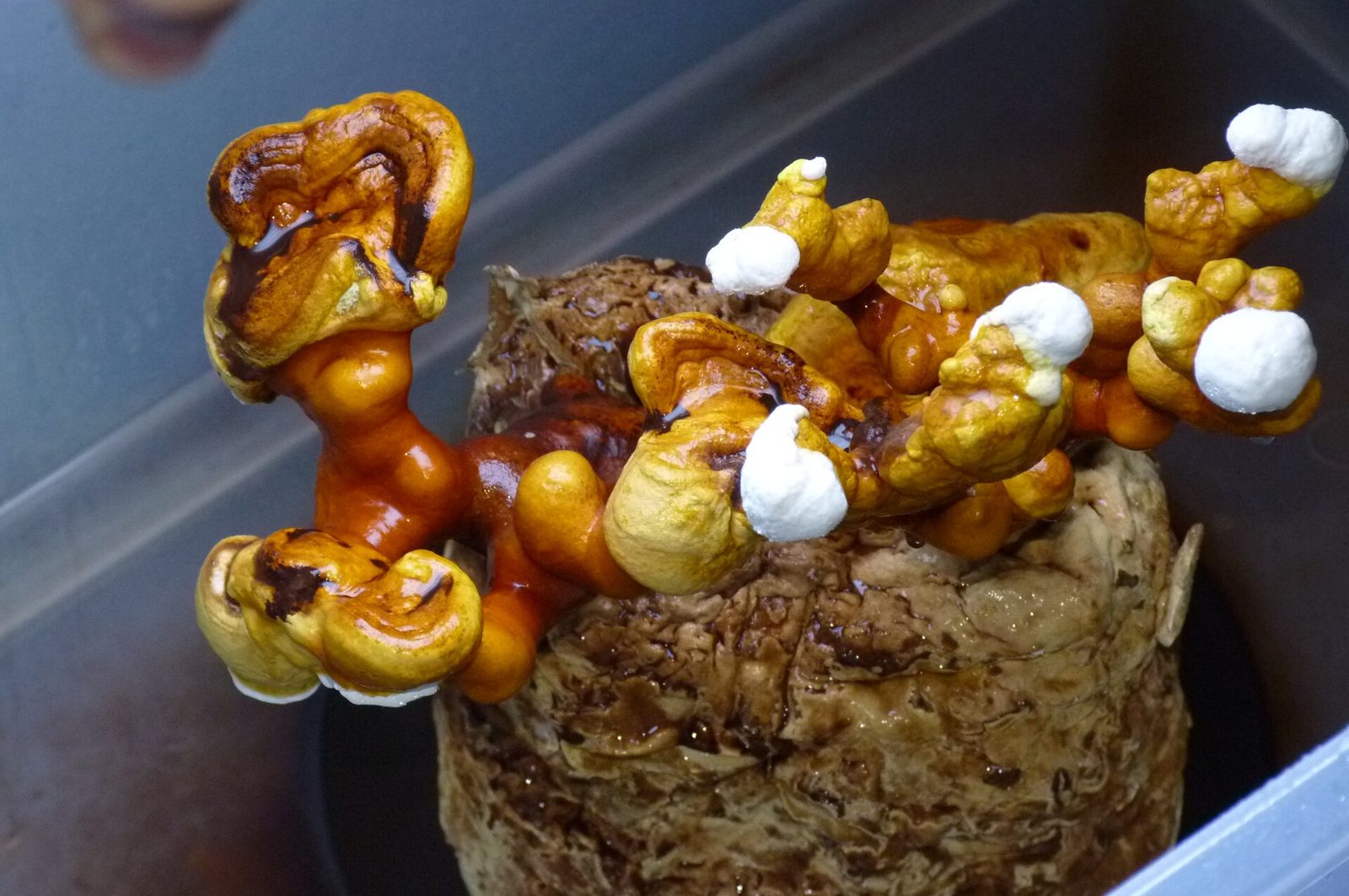
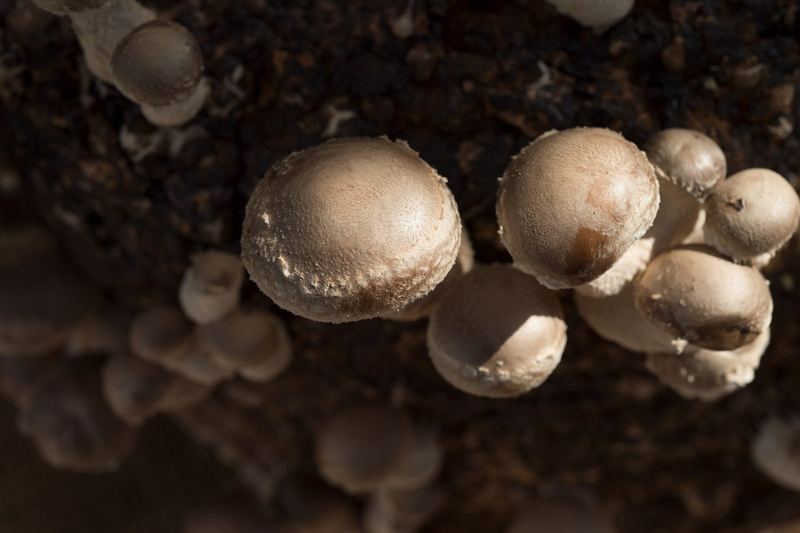
The guide gives no oxygen or CO2 figure for either shape. Cornell does say fresh air is brought in to keep CO2 below 1000 ppm for most species, but that is a general line, not a reishi target, so we do not treat it as one. The photo at the top of this page shows antler-type growth.
Reishi conditions by stage
| Stage | Days | Humidity | Light | Fresh air | Notes |
|---|---|---|---|---|---|
| Colonization (block route) | 20 days | Not stated | Not stated | Not stated | About 20 days from the start of the spawn run to complete colonization (OSU). |
| Antler growth (block route) | 28 days | Not stated | Not stated | Not stated | About 28 days of finger-like antler growth on the block (OSU). |
| Shelf forms (block route) | 75–90 days | Not stated | Not stated | Not stated | The shelf forms over the next 75–90 days (OSU). |
| Log spawn run | Not stated | Not stated | Not stated | Not stated | 9–12 months in OSU's description of the traditional method, 9–18 months in its step-by-step log guide. Logs sit in a greenhouse's warmth and humidity, off the ground on pallets. |
| Fruiting (any route) | Not stated | Shady and humid; no percentage given | Shade, 70–75% shade cloth over a greenhouse (OSU) | Cornell, general not reishi-specific: CO2 below 1000 ppm for most species | Not stated |
How to grow reishi on sawdust blocks
- Get a fruiting block. Oregon State says fruiting blocks start as 5-pound blocks of hardwood sawdust and bran, which are sterilized and then inoculated with grain spawn, and that you can buy them from local suppliers. Our spawn guide and substrate guide explain what the maker has done for you.
- Let the antlers form. Oregon State says the time from the start of the spawn run to complete colonization is about 20 days. The colonized block then begins forming finger-like antler growth, which takes about 28 days (OSU). Our sources give no colonization temperature for blocks.
- Prepare a shady, humid place. Oregon State says you can grow reishi in a greenhouse, on the forest floor or in a makeshift shady and humid space. For a greenhouse it says to cover it with 70–75% shade cloth. It also says to blend the surrounding substrate with sawdust or wood chips before planting the blocks.
- Plant the block there. The block route plants the fruiting block in that prepared space. Oregon State says the block is ready for use and planting after the antlers reach 1–3 inches. Our sources give no planting depth or spacing.
- Wait for the shelf. The shelf forms over 75–90 days (OSU). Natural logs and fruiting blocks can fruit twice a growing season, generally between April and August.
- Harvest at the right moment. Oregon State says fully developed mushrooms are ready to harvest about three months after pinning begins, and that reishi is ready when the margin of the cap turns from white to red. See harvesting reishi.
How to grow reishi on logs
Both Oregon State and the University of Kentucky treat logs as a proper route. Kentucky says reishi can be cultivated on logs in the same manner as shiitake, so our growing mushrooms on logs guide is a useful companion.
- Cut hardwood logs. Oregon State gives 2- to 4-foot lengths, 4 to 7 inches across, and says to select a healthy, relatively straight-limbed oak or maple. Kentucky also says oaks seem to be preferred, but beech or maple can be used.
- Inoculate within 30 days of cutting. Oregon State says this keeps moisture high and lowers the chance that other fungi take the log.
- Fill drilled holes with sawdust spawn and wax them. Oregon State uses sawdust spawn, and Kentucky says dowel or sawdust spawn. Cover each hole with food-grade wax so the spawn is not eaten by wildlife or contaminated by other fungi (OSU). No spawn rate is given.
- Run the spawn. Oregon State stores the logs in a greenhouse, off the ground on clean pallets, for a spawn run of 9–12 months in one passage and 9–18 months in its step-by-step guide.
- Move the logs to shade. Oregon State plants them in greenhouse trenches. Kentucky says logs may be buried horizontally after inoculation or a successful spawn run, and that some producers cover buried logs with hoop frames holding shade cloth.
- Keep them going. Oregon State says yields typically last one year for every 1 inch of host-log diameter, so a 6-inch log bears fruit for about six years. Kentucky says well-maintained logs can keep producing for at least three to five years.
Reishi care
Humidity
Light
Fresh air
Temperature
Common reishi problems
Harvesting reishi
Oregon State says reishi is ready when the margin of the cap turns from white to red, and that you harvest by twisting or cutting at the base of the stem. Our reishi harvesting guide covers the signs, the flushes and what we cannot say about drying.
What our sources do not tell you
We found no extension source giving a reishi colonization or fruiting temperature, a humidity percentage, a light level, a CO2 or oxygen target, a yield in weight, or any drying or storage method. The oxygen direction behind antler and shelf form is also not stated in the material we used. We found no cultivation text for Ganoderma tsugae, so this page covers G. lucidum only.
Grow these next
If you want a faster first success, lion’s mane is the better-documented sawdust-block mushroom, and shiitake is the usual first log project. For a very different, lab-style method, see how to grow cordyceps. The grow kits guide and our contamination guide apply to every route above.
Frequently asked questions
Is reishi hard to grow?
It is slower and less forgiving than the common mushrooms. Oregon State Extension says reishi is slower to form mature mushrooms than shiitake, oyster and lion's mane, and UF/IFAS lists it as a more challenging species to try after you have learned the basics.
What does reishi grow on?
Hardwood. Oregon State describes fruiting blocks of hardwood sawdust and bran, and hardwood logs inoculated with sawdust spawn. Oregon State says to select a healthy, relatively straight-limbed oak or maple for logs. The University of Kentucky adds freshly cut hardwood stumps, and says oaks seem to be preferred for logs, with beech or maple also usable.
How long does reishi take to grow?
On the block route, Oregon State gives about 20 days from the start of the spawn run to complete colonization, then about 28 days of antler growth and 75–90 days for the shelf to form, with fully developed mushrooms ready to harvest about three months after pinning begins. On logs, the spawn run alone is 9–12 months in one Oregon State passage and 9–18 months in another. The University of Kentucky says outdoor production takes six months to two years to reach harvestable mushrooms.
What temperature does reishi need?
Our sources do not give one. None of the extension documents we used states a colonization or fruiting temperature for reishi, so we do not offer a number. Follow your block or spawn supplier's instructions.
Why is my reishi growing as antlers instead of a shelf?
Oregon State says red reishi can appear as finger-like antlers or form a shelf, depending on the amount of oxygen in the environment. It gives no oxygen or CO2 figure for either shape, so we cannot tell you a target.
Sources
- Nontimber Forest Products for Small Woodland Owners: Reishi Mushroom Growing Guide (EM 9364), Oregon State University Extension
- Gourmet and Medicinal Mushrooms (CCD-CP-079), University of Kentucky Center for Crop Diversification
- Methods of Commercial Mushroom Cultivation in the Northeastern United States, Cornell Small Farms
- Growing Mushrooms at Home, University of Florida IFAS Gardening Solutions
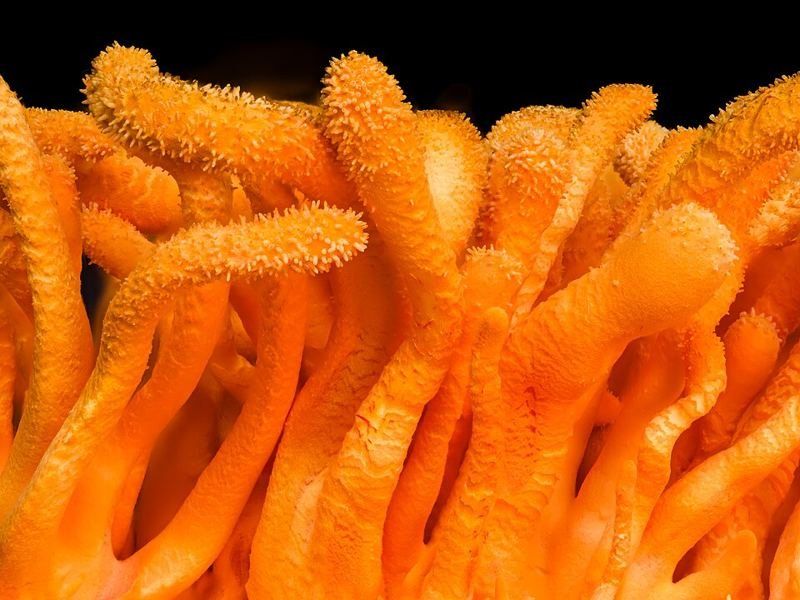 Cordyceps militaris
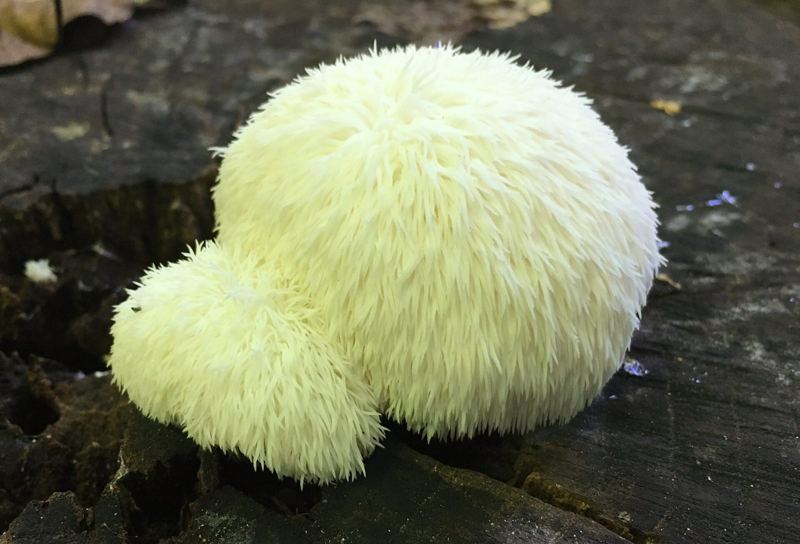 Lion's Mane
 Shiitake