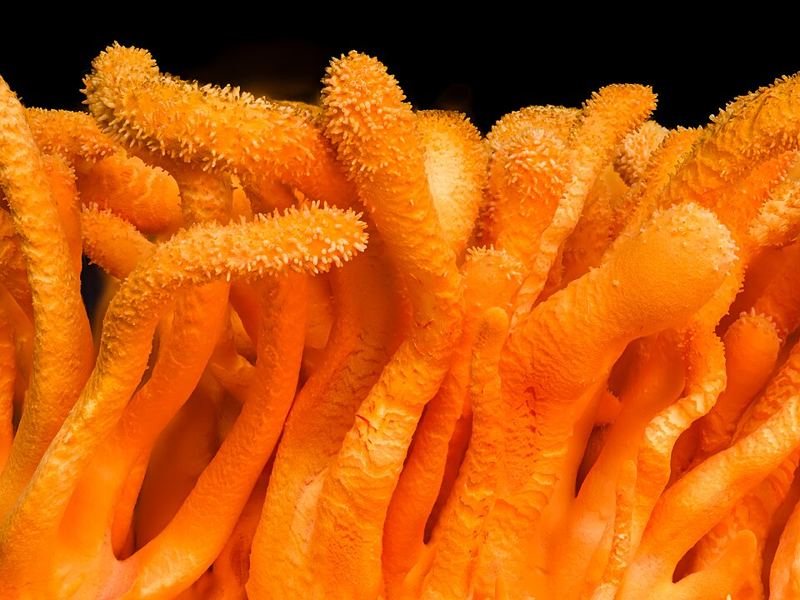
To grow cordyceps (Cordyceps militaris), the studies we use fill sterile containers with brown rice, inoculate them with prepared mycelium, keep them dark at 20°C (68°F) for about two weeks, then give them light until orange fruiting bodies form. This is indoor, controlled-environment work, closer to a lab bench than to a log or a bucket. Cordyceps is one of the mushrooms usually grouped as medicinal, which is why it sits in that section of this site. We cover growing only, and we make no health claims.
- Species
- Cordyceps militaris
- Substrate
- Brown rice in sterile containers (one laboratory study)
- Where
- Indoors, controlled environment; no outdoor data
- Colonization
- About 14 days at 20°C (68°F) in the dark
- Time to harvest
- 6 weeks after inoculation (one laboratory study)
- Fruiting
- Conflicting: 20°C under 500 lx, or 22°C under 1000 lx then 17°C dark
- Yield
- 3.5 to 11.8 g per jar in Cornell-cited trials; jar size not stated
- Difficulty
- No rating in our sources; sterility is the control point
Where the figures on this page come from
Unlike our reishi or lion’s mane pages, there is no extension guide to cordyceps here. The method comes from two peer-reviewed laboratory studies, and we use only their cultivation sections. One, a brown-rice self-cultivation study published in 2022 (PMC9598386), supplies the container recipe, the colonization period and the harvest timing. The other, a 2026 study (PMC13369557), supplies a second set of fruiting conditions. Cornell Small Farms supplies the yield trials and the sterility point.
Treat every study figure below as one laboratory’s result, not a rule for your room. The two studies also disagree with each other, and we show both. Some Cornell lines are general to mushrooms, not about cordyceps, and we label those.
Cordyceps conditions by stage
| Stage | Days | Temperature | Humidity | Light | Notes |
|---|---|---|---|---|---|
| Mycelium growth | 14 days | 20°C (68°F) | 60–70% (2026 study) | Dark | Both studies: dark at 20°C until the medium is fully overgrown with white mycelium. About 14 days. |
| Fruiting, brown-rice study | 14 days | 20°C (68°F) throughout | Not stated | 500 lx | First fruiting bodies appeared 2 weeks after the containers went into light. Harvest 6 weeks after inoculation. |
| Fruiting, 2026 study | Not stated | 22°C (72°F), then 17°C (63°F) in the dark for 10 h | 80% | 1000 lx for 14 h | Primordia form in about 7 days using the day-night temperature difference. |
How cordyceps is grown in the studies
- Fill containers with brown rice. The brown-rice study calls brown rice the most widely used substrate for this species. It used 500 mL polypropylene containers, each with 20 g of brown rice and 32 mL of liquid medium. The 2026 study’s substrate is not given in its cultivation section.
- Sterilize. The containers were autoclaved at 121°C (250°F) to avoid biological contamination (brown-rice study). Our substrate guide explains why heat treatment matters.
- Prepare the mycelium. The studies start from laboratory cultures. The 2026 study grew the strain on agar plates at 25°C (77°F) for 14 days, then in 100 mL of liquid broth on a shaker at 25°C for 3 to 5 days. The brown-rice study inoculated with that kind of prepared mycelium under a laminar-flow hood. No inoculation rate is given, and neither study describes a home-scale alternative. Our spawn guide covers the general idea.
- Colonize in the dark. Both studies hold the containers at 20°C in the dark until the medium is overgrown with white mycelium, about 2 weeks. The 2026 study gives 60–70% relative humidity for this stage.
- Move to light and fruit. Use either study’s fruiting conditions from the table above. In the brown-rice study the first fruiting bodies appeared 2 weeks after the move to light.
- Harvest. The brown-rice study harvested 6 weeks after inoculation, when mature asci with spores had formed on the fruiting bodies. It gives no picking method.
Yield
Neither study gives a yield in weight. Cornell’s methods book reports that in Fungi Ally’s cordyceps trials, controlling for strain, yield varied from 3.5 grams per jar to 11.8 grams per jar. Cornell does not state the jar size, so that range cannot be compared with the 500 mL containers above. It also says both cordyceps and shiitake showed large variation between strain and yield, which means the strain you start with matters. We found no named cultivar.
Care points
Sterility
Humidity
Light
Fresh air
Is cordyceps hard to grow?
Our sources give no difficulty rating. Cornell’s specialty book says some mushroom-producing parasites can also grow as saprophytes and are easily grown, naming cordyceps and maitake, but that is general context and not a rating for a home grower. What the studies show is a method that needs autoclaved containers, a prepared culture and clean-air inoculation. Our reading is that this makes it a project for someone who is already comfortable with sterile technique, and not a first mushroom. If you are starting out, our beginner collection is a better entry.
Problems
What our sources do not tell you
We found no source for cordyceps grow kits, log or outdoor cultivation, CO2 levels, storage, a picking method, an inoculation rate or a named cultivar. The 2026 study’s substrate is not stated in its cultivation section. Neither laboratory study gives a yield in weight. Drying and storage are outside what we cover here.
Grow these next
For a slower, hardwood-based project, see how to grow reishi. For something easier to start, lion’s mane grows from sawdust blocks and shiitake grows on logs. Our grow kits guide and contamination guide apply to any route.
Frequently asked questions
What does Cordyceps militaris grow on?
In the studies we use, brown rice. One laboratory study calls it the most widely used substrate for this species and filled 500 mL polypropylene containers with 20 g of brown rice and 32 mL of liquid medium. We found no log or outdoor cultivation data.
How long does cordyceps take to grow?
In one laboratory study, the containers sat in the dark at 20°C (68°F) for 2 weeks until fully overgrown, the first fruiting bodies appeared 2 weeks after light began, and harvest was 6 weeks after inoculation. That is one study's schedule, not a guarantee.
What temperature and light does cordyceps fruit at?
The two studies disagree. One kept 20°C (68°F) throughout fruiting under 500 lx. The other used 22°C (72°F) under 1000 lx for 14 hours, then 17°C (63°F) in the dark for 10 hours to form primordia. We cannot say which is better.
Can I buy a cordyceps grow kit?
Our sources do not cover kits, so we cannot tell you how one works or what it needs. Both studies we use start from a lab-prepared mycelium culture.
Is cordyceps hard to grow?
Our sources give no difficulty rating. Both studies use autoclaved containers and clean-air inoculation, and Cornell says sterility matters most for high-nitrogen media such as grain, so our reading is that it is not a beginner project.
Sources
- Cordyceps militaris brown-rice self-cultivation study (cultivation section only; PMC9598386), Peer-reviewed laboratory study, Antioxidants (2022)
- Cordyceps militaris fruiting-body cultivation study (cultivation section only; PMC13369557), Peer-reviewed laboratory study, Science Progress (2026)
- Methods of Commercial Mushroom Cultivation in the Northeastern United States, Cornell Small Farms
- Specialty Mushrooms, Cornell Small Farms
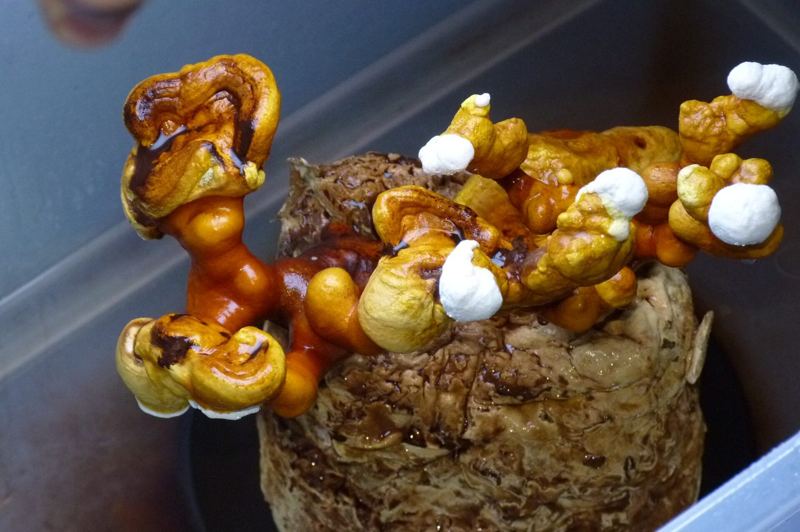 Reishi
 Lion's Mane
 Shiitake