
A reishi grow kit is a sterilized block of hardwood sawdust that has been colonized by reishi mycelium, so your job is to give it a shady, humid place and wait. Oregon State Extension describes exactly this as a fruiting block, and says blocks can be bought from local suppliers. This page is part of our reishi growing guide. It is candid about one gap: we found no extension source for a retail kit as such, so everything below describes the block method and leaves product details to your supplier.
What a reishi block is
Oregon State says fruiting blocks mimic natural logs in structure and function. They start as 5-pound blocks made from hardwood sawdust and bran, which are sterilized and then inoculated with grain spawn. Cornell’s list of species grown on sawdust blocks in indoor production includes reishi, which fits: the block is the sawdust route in a convenient size. Our spawn guide and substrate guide explain what the grain spawn and the sawdust-and-bran mix are doing, and our general grow kits guide covers what to expect from any kit.
We do not name products here. Check what your kit says about how colonized it is on arrival, because how far along the block is decides how much of the timeline below is still ahead of you.
What the block does after colonization
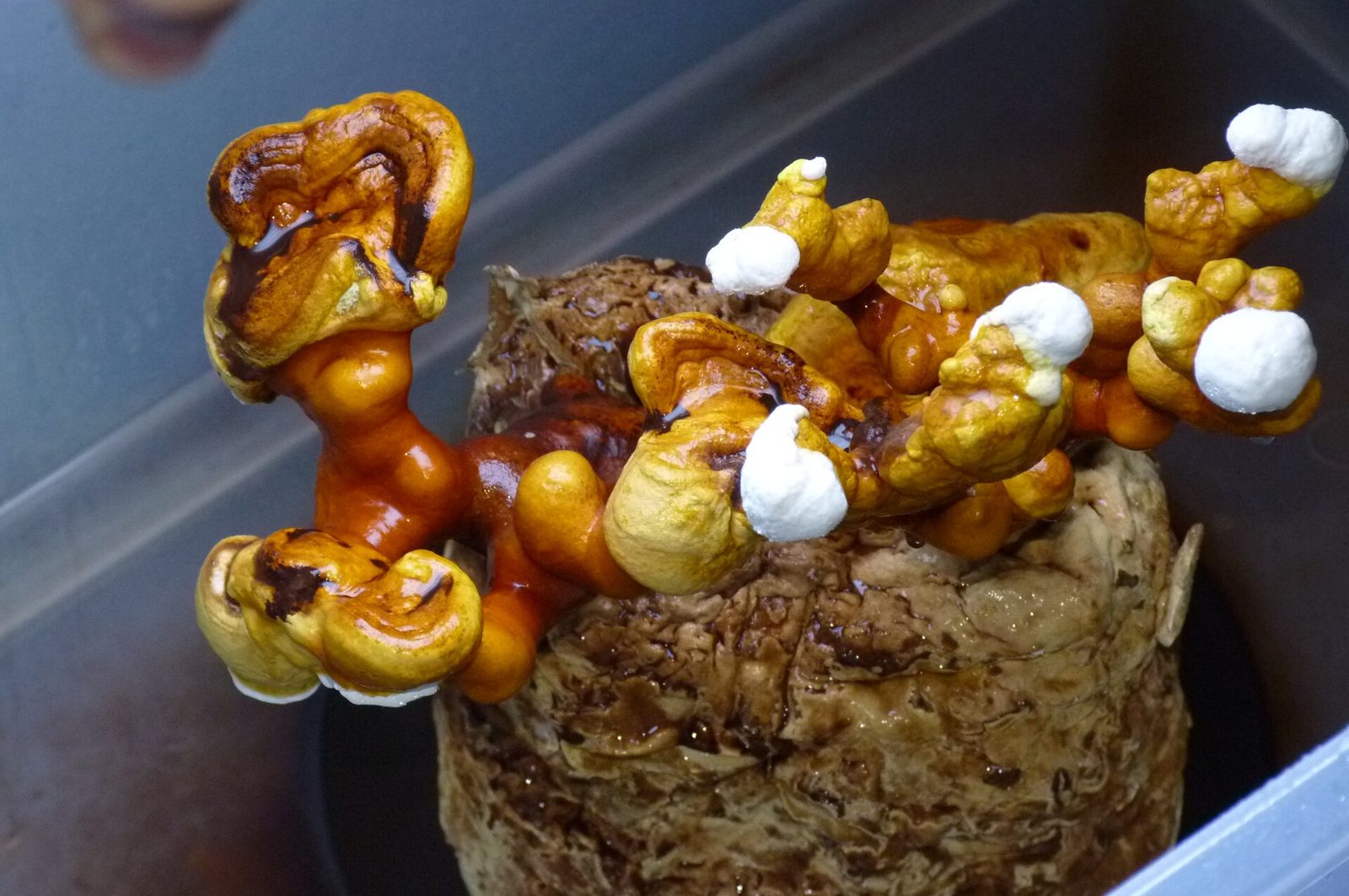
Oregon State says the time from the start of the spawn run to complete colonization is about 20 days. Its block timeline then has two stages after colonization. Once the antlers reach 1–3 inches, it says the fruiting blocks are ready for use and planting, and fully developed mushrooms are ready to harvest about three months after pinning begins.
| Stage | Days | Humidity | Light | Fresh air | Notes |
|---|---|---|---|---|---|
| Antler growth | 28 days | Not stated | Not stated | Not stated | The block begins forming finger-like antler growth, which takes about 28 days (OSU). |
| Shelf forms | 75–90 days | Shady and humid; no percentage given | Shade; 70–75% shade cloth over a greenhouse (OSU) | Cornell, general: CO2 below 1000 ppm for most species | The shelf, also called a conk, forms over the next 75–90 days (OSU). |
| Harvest | Not stated | Not stated | Not stated | Not stated | Cap margin turns from white to red (OSU). |
Antlers and the shelf are two shapes of the same mushroom. Oregon State says which one you get depends on the amount of oxygen in the environment, but it gives no oxygen figure. It also gives no temperature for any stage of the block route, so we show a dash rather than a guess.
How to fruit a reishi block
- Read the maker's instructions first. Our sources describe the block method, not any particular kit. The supplier knows how far the block is colonized and whether it is meant to fruit in the bag.
- Choose a shady, humid spot. Oregon State says reishi grows in a greenhouse, on the forest floor or in a makeshift shady and humid space. Its greenhouse is covered with 70–75% shade cloth. Full sun is not what it describes.
- Prepare the space. For planting blocks, Oregon State blends the surrounding substrate with sawdust or wood chips. That is its instruction for a planting bed, so treat it as the method behind the kit, not a requirement for a shelf-top kit.
- Watch the antlers form. About 28 days of finger-like growth is the first stage in Oregon State’s timeline.
- Wait for the shelf. It forms over 75–90 days. Reishi is slow, and Oregon State says it forms mature mushrooms more slowly than shiitake, oyster and lion’s mane.
- Harvest when the margin turns red. Oregon State says reishi is ready when the margin of the cap turns from white to red, and says to twist or cut at the base of the stem. See harvesting reishi.
Is a reishi kit a good first project?
Probably not. UF/IFAS lists reishi as a more challenging mushroom to try after you have learned the basics, and Oregon State says reishi is slower than the common cultivars. The block removes the sterile work, but the wait is still around 100 days or more from the first antlers to a finished shelf (28 days plus 75–90 days). If you want a quick first result, an oyster kit is better documented, and our beginner collection compares the options.
If something goes wrong
We found no extension text on contamination of reishi blocks. For logs, the University of Kentucky names blue-green Trichoderma as a very aggressive competitor, but that is log guidance. Our contamination guide covers general signs, and your supplier is the best source on a block’s own problems.
After the first harvest
Oregon State says natural logs and fruiting blocks can fruit twice a growing season, generally between April and August. It gives no rest or watering routine between flushes for a block, and no yield in weight. Our sources do not say how long a block lasts.
What our sources do not tell you
We found no retail-kit guidance, no temperature, no humidity percentage, no light level in lux, no oxygen target and no yield for reishi. If a kit maker gives those, use theirs and treat our timings as the shape of the process rather than a schedule.
Frequently asked questions
What is a reishi grow kit?
In our sources the closest thing is a fruiting block: Oregon State says reishi blocks are 5-pound blocks of hardwood sawdust and bran, sterilized and inoculated with grain spawn, and that they can be bought from local suppliers. We found no extension document that uses the word kit.
How long does a reishi block take to fruit?
Oregon State gives about 20 days from the start of the spawn run to complete colonization, then about 28 days of antler growth and 75–90 days for the shelf to form. A block that arrives partway through the process will differ.
Can I fruit a reishi block indoors?
Cornell lists reishi among the species grown on sawdust blocks in indoor production, but Oregon State's block method plants the block in a prepared, shady, humid space such as a greenhouse. Our sources do not describe fruiting a block in its bag on a shelf, so follow your supplier's instructions.
Will a reishi block fruit more than once?
Oregon State says natural logs and fruiting blocks can fruit twice a growing season, generally between April and August.
Sources
- Nontimber Forest Products for Small Woodland Owners: Reishi Mushroom Growing Guide (EM 9364), Oregon State University Extension
- Methods of Commercial Mushroom Cultivation in the Northeastern United States, Cornell Small Farms
- Growing Mushrooms at Home, University of Florida IFAS Gardening Solutions