
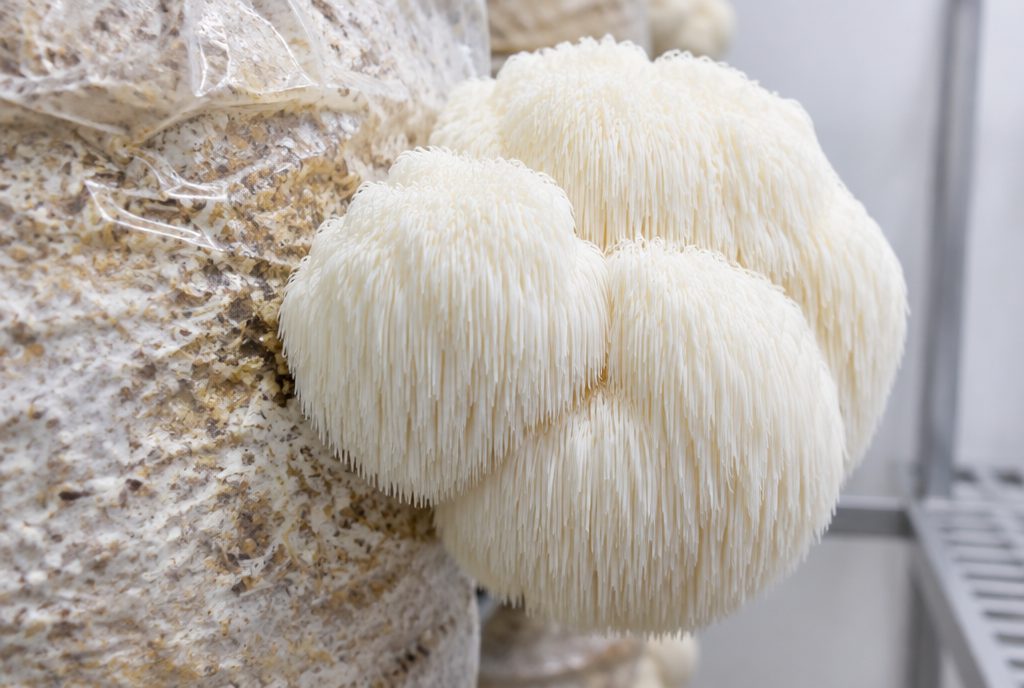
A lion’s mane grow kit is a block of sawdust substrate that is already colonized, so your job is to give it the right place to fruit. UF/IFAS describes a ready-made kit that way in its oyster guide: the fungus has already grown through the substrate, so you skip the spawn run and the sterile work. What is left is humidity, fresh air and keeping water off the mushroom. This page is part of our lion’s mane growing guide, and it is candid about one thing: we found no lion’s-mane-specific kit guidance in our extension sources, so much of what follows is general.
What a lion’s mane kit is
Our sources describe the kit idea rather than any particular retail product. Cornell says sawdust is the substrate that suits lion’s mane, so expect a block or bag of hardwood sawdust that the mycelium has colonized. Check the maker’s instructions for how to open the bag and where mushrooms will emerge, because that differs between products. Our grow kits guide explains what to look for in general, and our oyster kit page shows how UF/IFAS describes the same idea for a faster species.
What a lion’s mane kit needs to fruit
Extension guidance is thin here, so the table separates what comes from extension from what comes from one trial.
| Stage | Days | Temperature | Humidity | Light | Fresh air | Notes |
|---|---|---|---|---|---|---|
| Pinning and fruiting (extension) | Not stated | Not stated | 90% | Not stated | Fresh air exchange is a must | Purdue: raise humidity to 90% when mushrooms begin to pin. Avoid water trapped between the spines, which distorts the mushroom. |
| Fruiting room (Thai trial) | Not stated | 61°F (16°C) | 65–75% | 8 hours a day | Not stated | 16°C in a cropping room. The same paper's background sentence says 18–24°C (64–75°F), so the paper conflicts with itself. |
| Harvest | 47 days | Not stated | Not stated | Not stated | Not stated | 47 days after spawning in the Thai trial, which started from spawn, not a ready-made kit. Cornell: harvest when the teeth are about 1 cm (0.4 in) long and drooping. |
The Thai figures describe one study: bottles of rubber-tree sawdust spawned with grain spawn. They are a reference point for what a successful run looked like, not a promise for your kit. Where the trial and Purdue disagree on humidity (65–75% against 90%), we cannot say which suits lion’s mane best. Start with your kit’s instructions, then watch what the mushroom does.
How to fruit a lion’s mane kit
- Read the maker's instructions first. Our sources give no lion’s mane kit routine. The maker knows how the block was produced and how it should be opened.
- Pick a stable spot with fresh air. Purdue says fresh air exchanges are a must. A cool room is the safe aim: the Thai trial fruited at 16°C (61°F), though its own background says 18–24°C.
- Raise humidity around the block. Purdue says to increase moisture to 90% humidity when mushrooms begin to pin and fruit. Raise humidity in the air around the block, not onto the mushroom.
- Keep water out of the spines. Purdue says lion’s mane needs high humidity at certain stages, but water trapped between the spines can lead to distorted mushrooms.
- Harvest when the teeth are short. Cornell says to harvest when the teeth are about 1 cm (0.4 in) long and drooping downward. Our harvesting guide covers what to do next.
If something goes wrong
We found no extension text on lion’s mane contamination or pests, so we cannot list sourced signs for this species. UF/IFAS says blue, green, black or yellow spots signal contamination in oyster bags and that heavily contaminated bags are best discarded. That is oyster guidance, so check it against your kit maker’s advice. Our contamination guide covers the general picture.
What happens after the first harvest
Our sources do not say how many flushes lion’s mane gives or how long to rest a block. For oyster, UF/IFAS expects two to four more flushes after the first, depending on strain and surroundings, but we have no matching lion’s mane figure. Use your kit’s instructions, and compare with the oyster experience in our oyster guide if you want a sense of how flushes work.
What our sources do not tell you
There is no lion’s-mane-specific kit timeline, flush count or contamination guidance in our sources, and the temperature, light and 47-day figures come from one trial in Thailand. If you want a kit that is easier to forgive, oyster kits have far better documentation. For a garden project instead, see wine cap in garden beds.
Frequently asked questions
How long does a lion's mane kit take to fruit?
None of our sources give a time for a retail lion's mane kit, so follow the maker's instructions. For reference only, one university trial in Thailand, growing on rubber-tree sawdust in bottles, harvested mushrooms 47 days after spawning. A kit arrives already colonized, so you start later in that process.
What humidity does a lion's mane kit need?
Purdue says lion's mane needs high humidity at certain stages and suggests 90% once pinning begins, though that is general gourmet guidance. The Thai trial used 65–75% in its fruiting room. The sources differ, so follow your kit's instructions.
Should I spray the mushroom with water?
Purdue warns that water trapped between the spines can lead to distorted mushrooms. Keep water off the mushroom and raise humidity in the air around the block.
Can I get a second crop from the same kit?
Our sources do not say how many flushes lion's mane gives. For other species, such as oyster, extension sources describe repeat flushes. Check your kit's instructions for lion's mane.
Sources
- Growing Gourmet Mushrooms, Purdue Extension
- Harvest to Market: Specialty Mushroom Production, Cornell Small Farms
- D.I.Y. FunGuide: Grow Your Own Oyster Mushrooms at Home (SL448/SS662), University of Florida IFAS Extension
- Cultivation of Hericium erinaceus (Yamabushitake) on rubber and bamboo sawdust, Peer-reviewed trial in Thailand (PMC10432537)